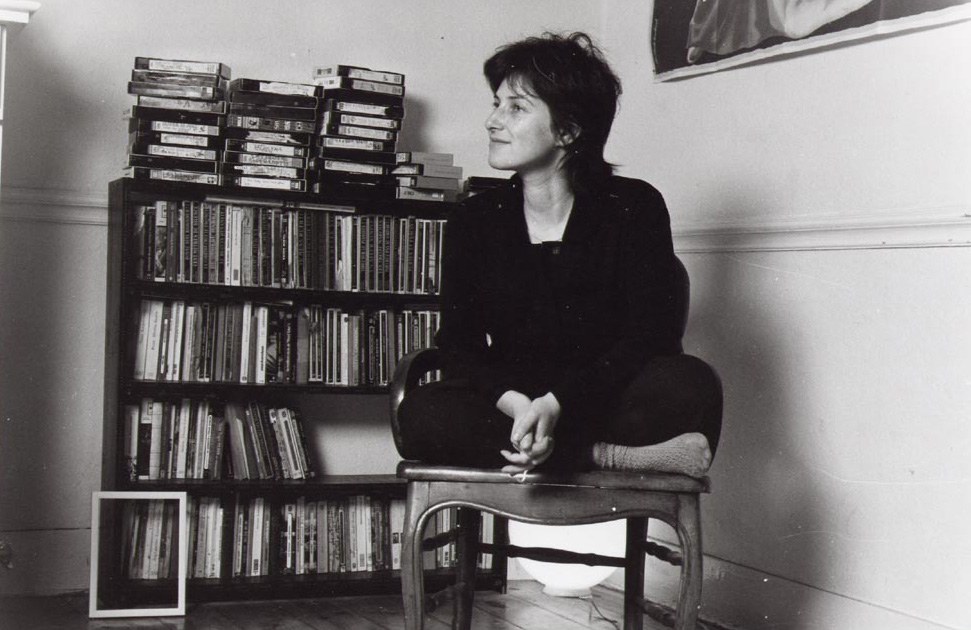
Belgian filmmaker Chantal Akerman, recently and lamentably lost to us — she committed suicide in late 2015 at the age of 65, not long after the death of her difficult but beloved mother, Natalia — made an eccentric, decades-spanning career out of lamenting, or observing the lamentation of, things and people and countries lost; none of them any less lost when, as is often the case in her films, they’ve been deliberately left behind.
The title of her 2015 documentary about her mother in twilight, No Home Movie, wryly captures the spirit of Akerman’s always tenuous modus vivendi — there may as well be a comma placed between “home” and “movie,” or else a colon. The sadness and gloominess in her work, about which her lonely, anxious mother complained to Akerman in one of the many letters we hear recited in voice-over throughout News From Home (1976), resonated profoundly, if half-accidentally, with the decade in which she first made her mark. If the initial notoriety of Jeanne Dielman, 23, Quai du Commerce, 1080 Bruxelles (1975) derived from its status as a feminist expose of the alienation, exploitation, and rage felt by women trapped within the banal brutality of patriarchy, considered in the context of Akerman’s subsequent body of work, currently accessible on the big screen courtesy of the Harvard Film Archive’s ongoing retrospective Breathing Through Cinema: The Films of Chantal Akerman (running through 10/22), it emerges as a particularly pointed instance of its director’s prevailing mood, which is a mood marked by dolor, albeit enlivened by curiosity and wit and often colored by half-embarrassed wist.
If there is a radicalism at play here (and there is), it isn’t utopian in nature. It bears more in common with the anxious, restless dreaminess of, say, Wim Wenders’ mid-’70s work, as filtered, especially early on, through the avant-garde formalism Akerman imbibed while working with and living around the denizens of the Anthology Film Archives in New York. Like Wenders in those years, Akerman brought a concern with longing and belonging–personal, familial, national, religious–to everything she did — and she did kind of a lot, ranging from the memoiristic essays (or poems) mentioned above through such quasi-documentaries as her post-Soviet travelogue D’Est (1993) and the elliptical Pina Bausch portrait One Day Pina Asked… (1983) and on into to her late-period narrative films, arguably best represented by the Proust adaptation, The Captive (2000).
There is so much that is wonderful and thoughtful, complex yet immediate, beautiful and sad to experience in the HFA’s retrospective that it’s difficult to select favorites. But not impossible: I reserve my most heartfelt fondness for two films–1974’s strange and lustrous Je, Tu, Il, Elle, arguably Akerman’s finest and most convincing demonstration that the rigors of avant-garde experimentation can coexist peaceably and movingly with highly personal, emotional material, and 1978’s semi-autobiographical Les Rendez-vous d’Anna, an interior travelogue tracing the barren trajectory of a female filmmaker (Aurore Clement) — and maybe of film, art, sex, and Europe, too — to Hotel Terminus, a journey both tender and alienated, searching and formally claustrophobic.
But everything here is of interest. Take a look at the typically excellent program notes provided by the Archive’s curators (and occasional others) and carve out an Akerman retrospective of your own.
Breathing Through Cinema:The Films of Chantal Akerman
Runs 9/8 to 10/22 @ Harvard Film Archive– click here for full schedule!