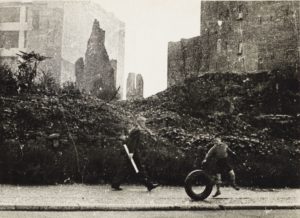
West Berlin, 1956, Arno Fischer, Inventur @ Harvard Art Museums
There are two things to say about Inventur – Art in Germany, 1943-55, the current show at the Harvard Art Museums, that could be taken as criticism, but are instead praise. First, it is too small; only a few mid-sized rooms, you suddenly come to the end, left wanting more. That one wants more is high praise; the best desserts are tiny, delicious servings gone too quick. For a show with not exactly the lightest subject matter – art in the decimated and depressed post-WWII Germany – that it is sweet enough to call for a far larger exhibit is impressive. The second, the cause for its success, is that it is a far better show of art than it is a historical exhibition, with a beautiful collection of work that shows more than the museum tells.
To be sure, The HAM, with curator Lynette Roth, has displayed a fascinating part of history, and there is much to be learned from the exhibit. What Roth has done is not put an emphasis on a heady educational narrative, but rather let the work speak for itself, with poignant accompanying texts to illuminate the artist’s personal context. The result is that the small pieces of text give enough concrete information to let the individual works come together in building the narrative of post-war Germany, one of intense emotions, chaos, and rapid change.
Of considerable help – and pure delight – is that the work is overall outstanding. Wilhelm Rudolph’s “Dresden Destroyed” series, a selection from over 200 drawings of the bombed-out streets of the artist’s home city, is disturbingly beautiful, and not to be missed. A Schiele-like drawing by Gerhard Altenbourg, “Ecce Homo Dying Warrior”, hauntingly captures the artist’s grief over a young Russian soldier he killed at the eastern front. A late Otto Dix shows the artists supreme ability at expressive representation, and is worth going to see by itself.
To Ms.Roth’s further credit, the show includes a large amount of work that does not deal directly with the historical context; pieces of expression and formal experimentation. Many of the artists clearly picked back up on pre-war, pre-Nazi-censorship trains of thought, using collage, printing, and atypical material to produce works equal parts gorgeous and fascinating as art history. Ernst Wilhelm Nay’s picassoesque gouaches are standouts. So too is a 1950 Hermann Glockner relief sculpture, a material experiment which would have caused stirs in America. There are multiple Hannah Hochs and Hans Uhlmanns, all sublime.
The last part of the show gets a bit awkwardly cramped, but almost appropriately, as it hurries to capture the dissonance between the ransacked East Germany and the suddenly developed West Germany. Arno Fischer’s three photos capture that eloquently, and there are several interesting examples of West German industry and design. The most surprising work of the whole show is the wild, magnificent painting “Carnival Feast’, by Harold Duwee, which is simultaneously a sharp critique of the West Berlin life, a depiction of the uncertainty from a legacy of trauma of two harsh post-war periods, and a bold, sexual forebearer of German Neo-Expressionsim.
Yet despite the show’s excellence, there is one glaring flaw, which arguably needs to be addressed by Ms.Roth and the museum. Can there be a worthwhile dialogue on WWII Germany that does not include the voices of the war’s truest victims? There is a lack of art from any holocaust survivors or artists from those most persecuted peoples, as if to suggest there were no Jews, people with disabilities, or Roma making art in Germany during the period. It is not a damnable offense (though, given today’s global resurgence of neo-nazism and facism, it does give me extra pause) but rather a sorely missed opportunity for another fascinating perspective on those post war years.

Otto Dix, 1946