Was I absolutely blown away by Some Like It Hot? No, not really. Its score and chase scenes make you sigh, “They don’t make movies like this anymore,” and its situational humor holds up relatively well. Much of its longevity is due to the simple fact that they dared to dive into gender and sexuality in this manner, even unintentionally. The charming, last “great” performance by Marilyn Monroe is also a cornerstone of its legacy, though Jack Lemmon was the only member of the main cast to get an acting nod among the film’s six Academy Award nominations.
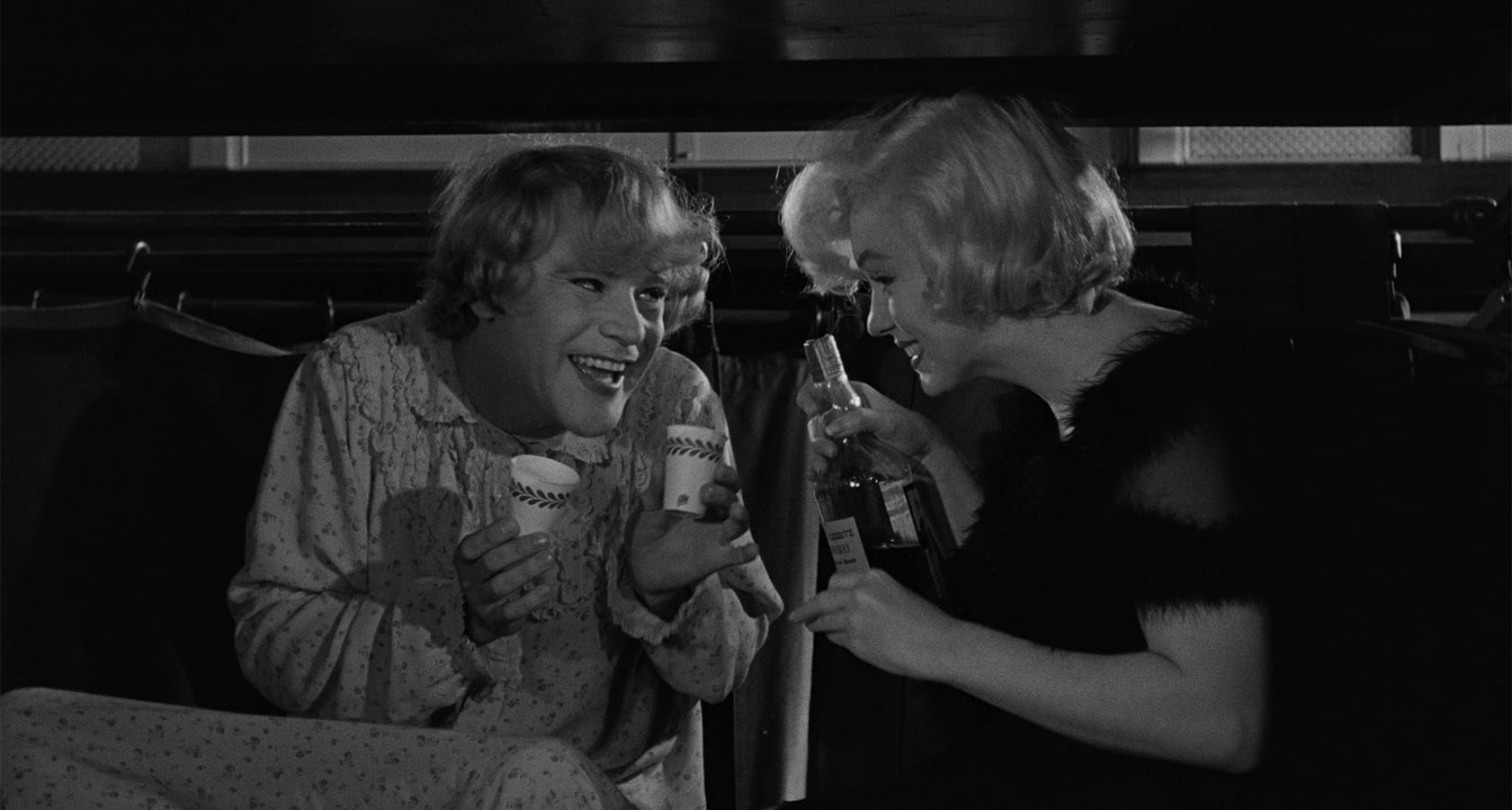
Monroe’s role is actually a supporting one. Some Like It Hot centers on Joe (Tony Curtis) and Jerry (Lemmon), two Prohibition-era jazz musicians who happen to witness a mob hit and are forced to flee Chicago. Their best shot is adopting female personas and joining a women’s band that is leaving for Florida shortly. Jerry was eager to take the gig earlier, just for the all-expenses-paid trip, yet the story locks into place when he does his first bit of feminine gender performance with ease: He calls the recruiter back and uses a higher-pitched voice, which is lightly satirical but largely convincing.
From there, the film exhibits a very nonplussed attitude about Joe and Jerry discovering what comes naturally and is enjoyable, and what is bothersome or unsettling. Walking in high heels? They have no idea how the ladies manage it. Impromptu late-night cocktail parties with a newfound group of girlfriends? Overwhelming but delightful. Being eyed by every man they encounter? They never knew how odious it could be. Jerry also asserts a bit of autonomy in the endeavor as he decides his name will be Daphne, one he simply likes better than the boring gender swap of Jerry to Geraldine.
After joining the band and boarding the train, the duo meets Monroe’s effervescent Sugar Kane. Genial and freewheeling, she’s fallen in love and been abandoned too many times, taking a job with what she perceives to be a second-rate band to get away from exploitative saxophone players. She also doesn’t see herself as particularly smart, but the character is humbly self-aware and sweetly sociable, there to make friends and find a rich new beau. There is an underlying sadness to her, but she puts on a smile and keeps playing, drinking, and flirting her way through life.
When the entourage reaches their Florida hotel, Joe doubles down on gender fluidity, switching between presenting as Josephine and the new persona of “Junior” (the heir to an oil fortune he made up to woo Sugar) at a wildly rapid pace. Yes, Sugar should realize these two people have the same face. The effect lands somewhere between a shrug at the flimsy logic of old-school films and the feeling that the writers are doing wrong by Sugar, so she can truly live up to her claims of having no brains.
Meanwhile, Jerry only gets more into his drag performance, at first resisting, but then falling when he is courted by an actual millionaire with a yacht, Osgood Fielding III (Joe E. Brown). Between the two main characters’ arcs, it is clear that, despite the elements that are awkward by today’s standards, Some Like It Hot has remained such a cultural landmark because it portrays gender creativity in a generally positive light.
And this theme goes much deeper than the immeasurably iconic final line, though it will always be a banger. The cross-dressing plot primarily leads to Joe and Jerry appreciating the plights of the women around them and forming meaningful human connections. You could argue that the construct is framed negatively due to Joe using it to deceive Sugar, but her heartbreak after Junior leaves her is given real heft, buoyed by Monroe’s ethereal moment singing “I’m Through With Love.” Moreover, she is just as casually accepting of the whole thing as Osgood, after her breath is taken away by Josephine kissing her in full view of everyone on stage.
On the flip side, by the time Jerry receives a proposal from Osgood, he is giddily swooning as well as enamored with the diamond bracelet he was gifted. Joe’s instructions to him to recite the mantra “I’m a boy” become just as oppressive as when it was “I’m a girl.” Moreover, when they talk about the alleged wrinkle in the engagement, the language used is somewhat infantilizing of homophobia itself: “There are laws, conventions,” Joe says. For these characters, there is also a law that says that you can’t drink alcohol, illustrating how well such things hold together.
The film gets its title from a throwaway line, when Sugar is speaking to Joe (as Junior). She mentions she is in a jazz band, and he, keeping up his sophisticated millionaire persona, says he prefers classical, but he supposes “some like it hot.” It’s another nonchalant moment that implies a sense of (feigned) superiority but not outright judgement. It’s a shrug, an acknowledgement that everyone is their own person. “Some like it hot…nobody’s perfect…,” words that are at the center of Billy Wilder’s Hays Code-killing comedy that is still making us laugh today.
Some Like It Hot
1959
dir. Billy Wilder
121 min.
Screens Sunday, 7/19, 2:00pm @ Coolidge Corner Theatre
Part of the repertory series: Happy Birthday, Ms. Monroe