To say that no one makes movies like Mark Jenkin would be an understatement. His last feature, Enys Men, was less a narrative film than an incantation, a series of cryptic images, rituals, and unnamed characters designed to make you feel the story rather than understand it. Jenkin’s latest, Rose of Nevada, is marginally more conventional— it contains dialogue, recognizable stars, and a plot which can be more or less described in a sentence or two— but it’s still as haunting, hypnotic, and elliptical as any of its director’s enigmatic work.
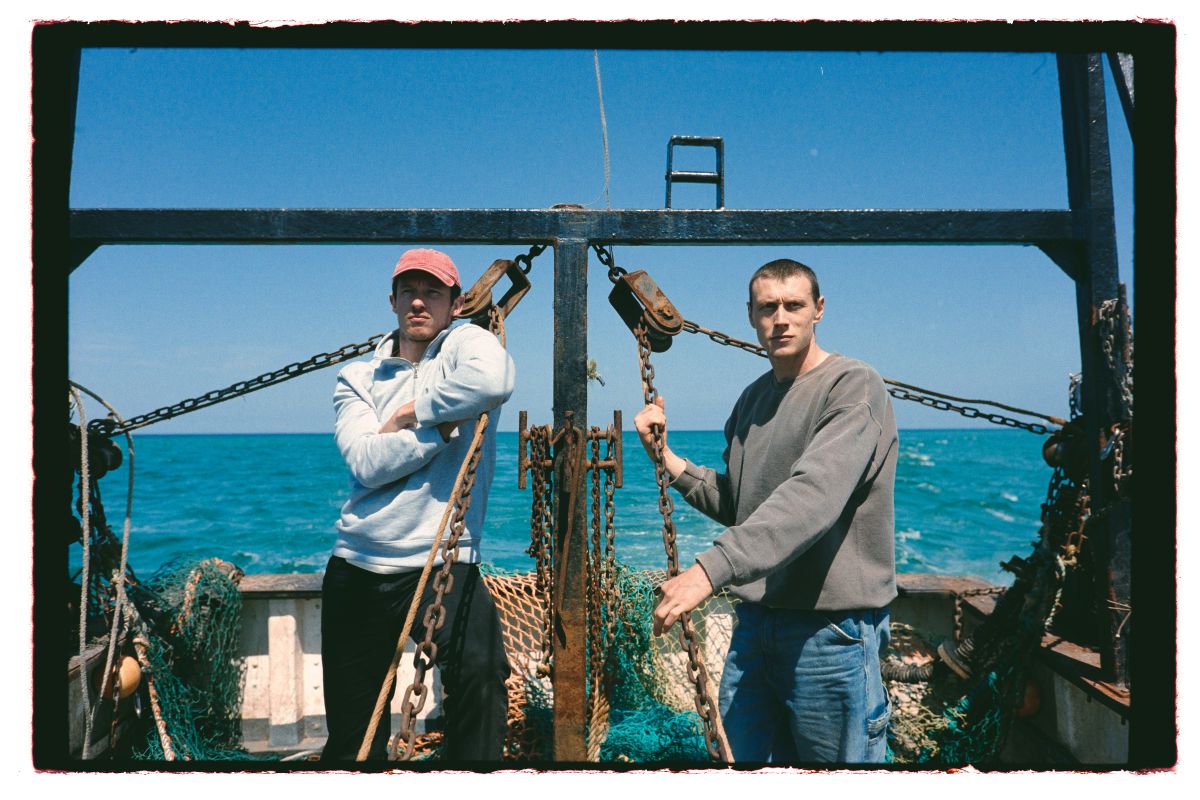
The Rose of the title is a fishing trawler, which casually floats into the harbor of a small Cornish village thirty years after its mysterious disappearance. Whether out of arcane duty or the fact that they simply don’t have a lot of boats to go around, the local authorities waste no time in getting it back into shipshape and sending it out for its next run. Rounding out the new crew (the original hands, needless to say, are nowhere to be found) are cash-strapped family man Nick (George Mackay), freewheeling drifter Liam (Callum Turner), and skipper Murgey (Francis Magee), a rough-and-tumble salty dog who no one seems to have seen before and who may or not be a ghost. Of the three, Nick is clearly the most apprehensive about setting sail on the once-doomed vessel, not least after finding etched into his headboard the words “GET OFF THE BOAT NOW.”
This new crew of the Rose of Nevada seems to have better luck than the last one; they catch their fair share of fish and return safely to port. The only problem is that they’re early— thirty years early. Returning to the village, Nick and Liam find themselves welcomed back as if they were the ship’s original hands: Nick as the troubled son of the elderly couple next door, Liam as the father of the girl with whom he’d struck up a flirtatious relationship in the present. As Nick gathers his bearings, he tries to figure out how to return to his wife and daughter in the 2020s— and what their presence means for the village in the 1990s.
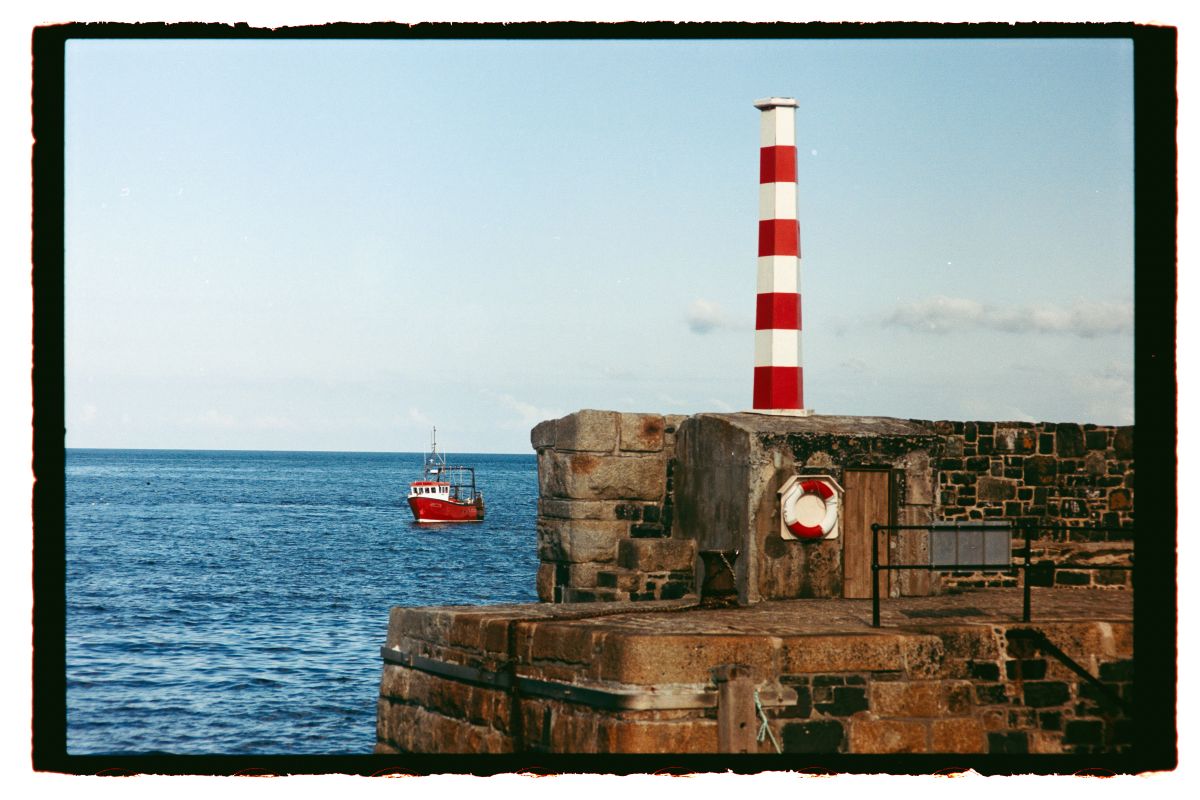
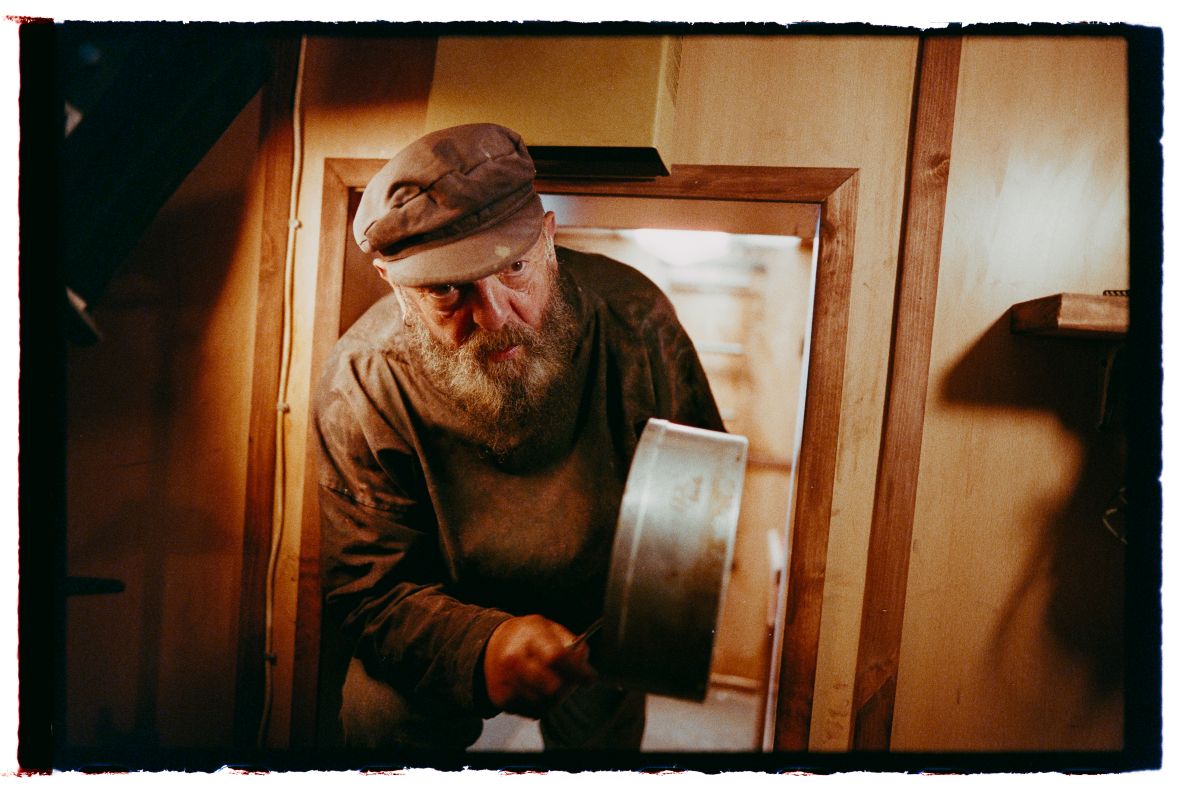
Described in broad strokes, Rose of Nevada sounds like it could be an It’s a Wonderful Life riff, and there’s certainly a bit of George Bailey in the way Nick dashes around the village trying to figure out why nobody remembers him. But Jenkin’s cobblestone roads are a far cry from Frank Capra’s Hollywood Main Street. The opening shots are not of human beings, but of jellyfish and patches of rust, communicating that there’s just as much soul in the objects and environments as the people who inhabit them. Indeed, Jenkin’s camera takes as much interest in the mechanics of fishing— the nets and winches and piles of gutted fish— as in the fishermen themselves. When we do see faces, they’re weathered and eldritch. Even the “name” actors look alien in this environment (though they kind of do anyway; if they ever make a glossy Hollywood biopic of reclusive cult musician Jandek, Mackay is my #1 casting choice). It looks as if the film itself might have been fished out of a ghost ship’s hull, strange and ancient and possibly not of this astral plane.
It’s clear that Jenkin exercises an enormous amount of control over the look and feel of his film. As in Enys Men and his debut feature Bait, Jenkin shot the film himself on a handheld 16mm Bolex camera, the kind favored by film students or AV-savvy ‘70s dads. By using vintage equipment and an occasionally unsteady hand, Jenkin lends the film a documentary flavor; we, or Jenkin, become a sort of unseen character, hovering just over the protagonists’ shoulders (frequently a scene will end in a flash, as if the camera literally ran out of film). In addition to director and cinematographer, Jenkin serves as writer, producer, editor, composer, and sound designer. Those last two duties in particular are here so entwined as to be inextricable. The music, largely played on analog synths and solo electric guitar, is lightly distorted, as if played through blown-out speakers or a dirty tapehead. By taking on so many roles, Jenkin lends the film a rare sort of aesthetic unity, each element working in tandem to make the film the nigh-inexplicable object that it is.
Yet for all of the formal eccentricities and narrative opacity, there is a humanism to Jenkin’s work which is perhaps not a world removed from Frank Capra after all. When the lads find themselves timewarped to the past, their first clues don’t come in the form of outmoded technology (save for a ‘90s-style CD-flipper jukebox, which, as an aging Millennial, I took as a personal attack). Rather, the big tell is how alive everything is. The pub, previously home to a handful of bedraggled regulars, is teeming with activity; the paint on the post office is fresh and vibrant rather than faded and peeling; the malaise of modern rural poverty which would envelop the town is decades away. Liam is more than happy to take advantage of his new situation; here, unlike in the present, he has a home, a job, and a loving family. Nick, with more to lose, is more apprehensive, but even he is slowly moved by the fact that, by providing food for his village, he just might be saving them from a sorry fate. Time travel movies are often defined by their protagonists trying to “fix” the present; few take the time to consider what the presence of the time-travelers means for the denizens of the past.
Like Jenkin’s previous work, Rose of Nevada is perhaps an acquired taste. It moves to its own shaggy rhythm, and those looking for a more conventional sci-fi parable might do better to stick with Doc Brown and Marty McFly. But for those able to slow down their internal clock and take a ramble down its craggy seaside, Rose of Nevada may be one of the best films of the year— certainly among the most unique, and one which I expect to be turning over in my mind for weeks and months to come. Mark Jenkin is one of the most unique voices currently working in cinema, and I look forward to our next voyage into his haunted sea.
Rose of Nevada
2025
dir. Mark Jenkin
114 min.
Opens Friday, 7/10 @ Coolidge Corner Theatre