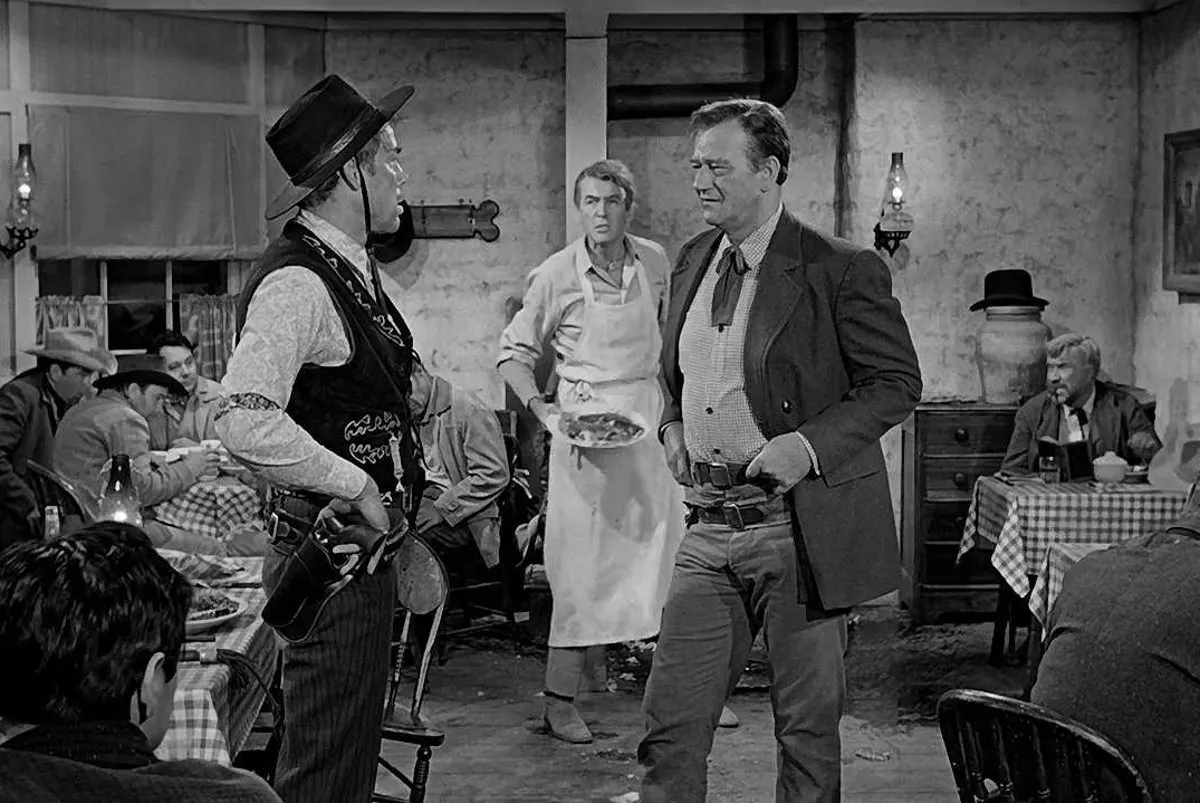
Politicians, lies, statehood/individualism, and legend are all compelling facets of The Man Who Shot Liberty Valance, a painterly venture into the pointlessness of violence in the Wild West. Racism may litter John Ford’s pessimistic Western in its single, cartoonish Black character, Pompey (Woody Strode), but for a ’62 period piece about law entering the West, Valance is a relatively progressive, pensive flick. The film begins when a U.S. senator named Ransom “Ranse” Stoddard (James Stewart) and his wife, Hallie (Vera Miles), arrive in Shinbone, a frontier town somewhere in the Western USA. As older faces familiar to the pair wilt, younger ones glare, perplexed. As the current editor of the town’s paper, the Shinbone Star, persists in questioning Senator Stoddard’s arrival, a morose truth is revealed: Ranse is here because a local rancher, Tom Doniphon (John Wayne), has died. He tells this editor the story of their connection, dating back decades to before Shinbone connected to the rest of the U.S. via railroad—a grandly empowering, part-legend and part-truth tale about the goodness of civilizing America that takes up Valance’s duration.
As a lawyer, the “younger” Ranse—who, along with Tom, doesn’t actually look much younger, given that Stewart and Wayne are here in their 50s—hopes to establish honest-to-God law throughout the unincorporated territories. He quickly learns how difficult that will be after being beaten, robbed, and left in the desert by Liberty Valance (Lee Marvin) and his gang of dung-filthy outlaws. Ranse is found by a young and very alive Tom Doniphon—a tough, self-assured farmer adorning cowboy spurs, hat and all—and his handyman, Pompey (Woody Strode), who takes the injured Ranse to Shinbone to heal. There, he meets others in the town like Tom’s then-girlfriend, Hallie, the cowardly town Marshal, Link Appleyard (Andy Devine), restaurant-bar owners Peter (John Qualen) and Nora Ericson (Jeanette Nolan), and the Shinbone Star’s first drunkard of an editor, Dutton Peabody (Edmond O’Brien), and tries settling in. Finding the town’s “every man for himself” ideals and widespread illiteracy to be major problems in defeating Valance and retaining the town’s independence, Ranse is now driven to free the town from its big raiders and big government, despite Doniphon’s mild opposition. The slickest shooter might not be enough to stop the plain and honest.
Frankly, The Man Who Shot Liberty Valance deserves a 200-page analysis on all its different ideas, symbols, metaphors, moods, and racist weaknesses, but alas, that’s for a different time and place. John Ford’s made many a Western in his time. While Liberty Valance is merely one of his many masterpieces, it’s also his grimmest yet most realistically progressive work for a plethora of reasons. Picture-perfect rocky backdrops, delightfully worn-in 1890s-ish sets and costumes, devoted performances, and rich metaphors aside, Liberty Valance demonstrates how the U.S. is a wildly two-headed nation that still refuses to reform itself. One head (Ranse) uses freedom and opportunity to establish civility, public decency, and a moral code on which America builds its many settlements; the other (Tom) interprets this freedom as meaning everyone fights for themselves, living in pure self-interest because law means nothing beyond what can be handled by bullets. For the former, beauty comes in the form of social order, while for the latter, it comes in self-picked and homegrown cactus roses (e.g., doing it yourself, no matter how rough things get). In the time of the Wild West, as beings like Ranse bring change from their eastern homeland, it’s hard to see how people like Tom and the much less honorable Liberty Valance would come to accept without being killed, as Tom says to Ranse himself: “I know those law books mean a lot to you, but not out here. Out here a man settles his own problems.” Yet despite being surrounded by such men who “settle [their] own problems,” Ranse and the beautiful American promise of the U.S. Constitution—that “We hold these truths to be self-evident that all men are created equal” (though, ironically, Pompey’s being a two-bit side character with no last name who helps the white protagonists defeat their white enemies is Liberty Valance’s most significant problem)—press on, as the increasingly town-famous lawyer teaches the uneducated Shinbone population how to read/write and the values of a free press through Dutton Peabody’s paper, lectures about the importance of statehood, and even elections for new representation in the ever-expanding American political landscape.
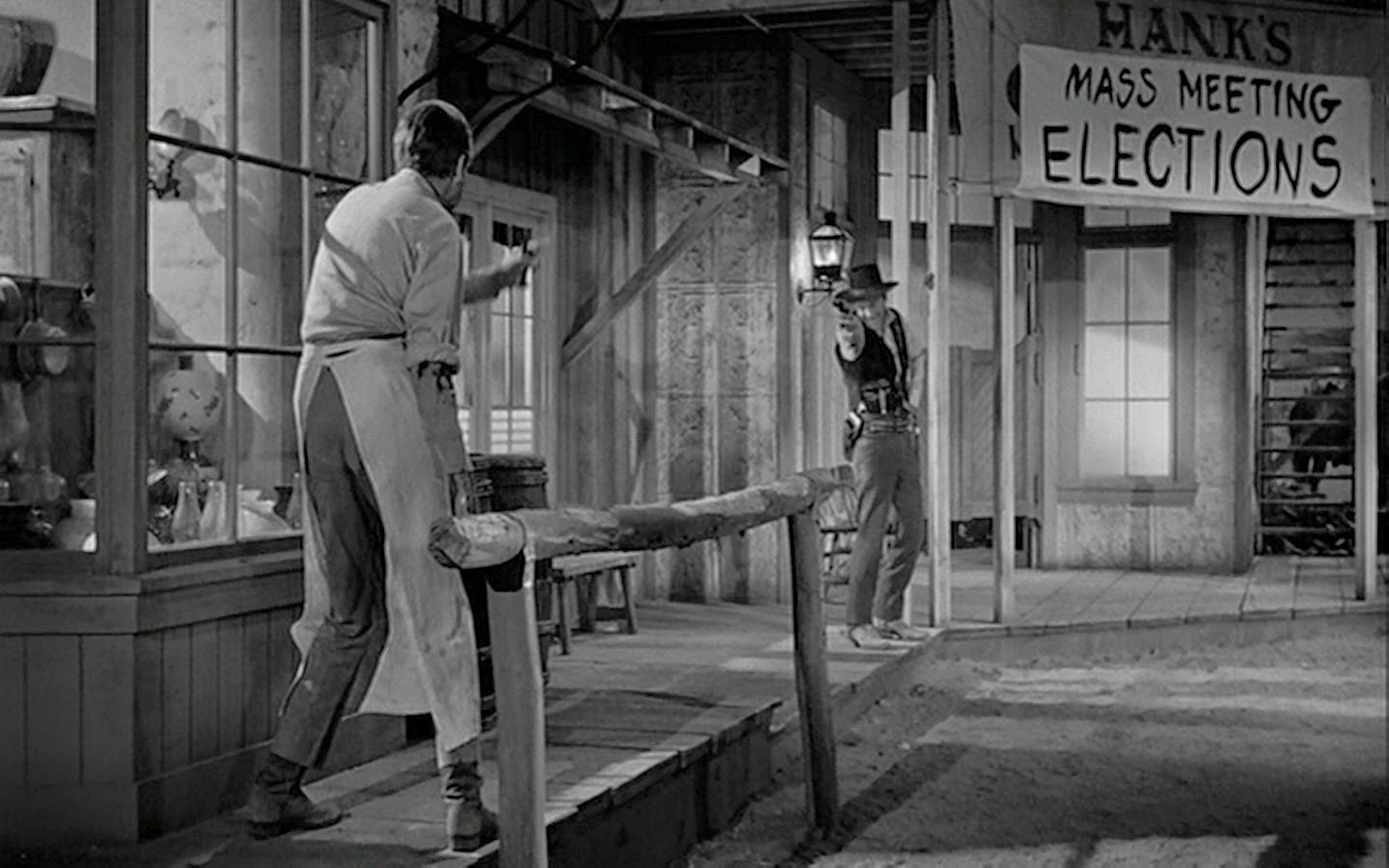
As much as Shinbone’s intellectual (and hopefully economic) state developed both because of Ranse and the country-connecting railroad built shortly after Ranse’s first day in town, The Man Who Shot Liberty Valance’s true beauty lies in its central tragedy. Tom, preferring life before this grand expanse, had his life set in stone: with plans to marry the mesmerizing Hallie, he was building a new bedroom extension in his small, desert-shaped ranch home. Then, along came Ranse to change Shinbone’s soul and unknowingly take too much of Tom’s livelihood away from him. As already demonstrated by the film’s older constituents’ arrival for Tom’s funeral, Tom died a poor rancher, or a nobody: “Who’s Tom Doniphon?” asks the Shinbone Star’s newest editor-in-chief. All that’s left of him is a burnt-down husk of his former ranch, a somberly thankful Senator Ranse, and a brokenhearted Hallie, the latter of whom is unspeakably devastated by her former lover’s absence. It’s she who picks out and places one of Tom’s homegrown cactus roses on his coffin, after all. In the past, despite Tom’s mild dislike of the law’s constraints, he never wavered in his support for Ranse’s cause; he sacrificed everything not only to improve the lives of all Shinbone residents but also to bolster Ranse’s credibility as a local legend, which eventually landed him a political career. Despite his own nature standing much closer to that of Liberty Valance, he, too, wants Shinbone’s residents’ to achieve true prosperity and peace: “You taught [everyone] how to read and write; now give [them] something to read and write about!” he commands a hesitant Ranse who’s just been nominated as the very senator Shinbone wants to stand up to big, ranch-destroying government. After all this, though, what does Tom have left? Not even his “… always pretty when you’re angry” girlfriend to keep him company. Anybody would fall off the wagon after fighting for everybody else to win while you lose.
Though Tom’s story is morose, his Black right-hand man, Pompey, is by and large Liberty Valance’s biggest flaw. He’s the only character with no last name; he probably develops the least out of everyone; all he does is help white people and come across as uneducated in his stuttering recitation of the U.S. Constitution. Despite the behind-the-scenes upheaval that John Ford attempted to distract with—Ford, angered by James Stewart’s pointing out how Woody Strode’s costume for and character of Pompey was racist, lambasted the actor in front of the rest of the cast and crew for not “…lik[ing] Woody’s costume. Now, I don’t know if Mr. Stewart has a prejudice against Negroes”—Pompey’s plainly insulting. Though Strode himself didn’t deny Stewart’s potential racist tendencies (and Ford wasn’t exactly professional, as he constantly lamented John Wayne’s failed football career), it’s hard to ignore that Pompey is an instinctively stereotypical character who doesn’t belong in what’s otherwise a heartily progressive, patriotic film. Nevertheless, there’s so much to absorb from the rest of The Man Who Shot’s dead-on, intriguingly political action that Pompey and a slight lack of big governance’s impact scarcely distract. For Western film fans, old cinema diehards, Wayne, Stewart, and Strode lovers, and those looking for a hopeful depiction of what working towards the American dream should look like, The Man Who Shot Liberty Valance is equally pulpy and evocative.
1962
dir. John Ford
123 min.
Screens Monday, 7/13, 7:15 p.m. @ Coolidge Corner Theatre
Part of the ongoing repertory series: Big Screen Classics