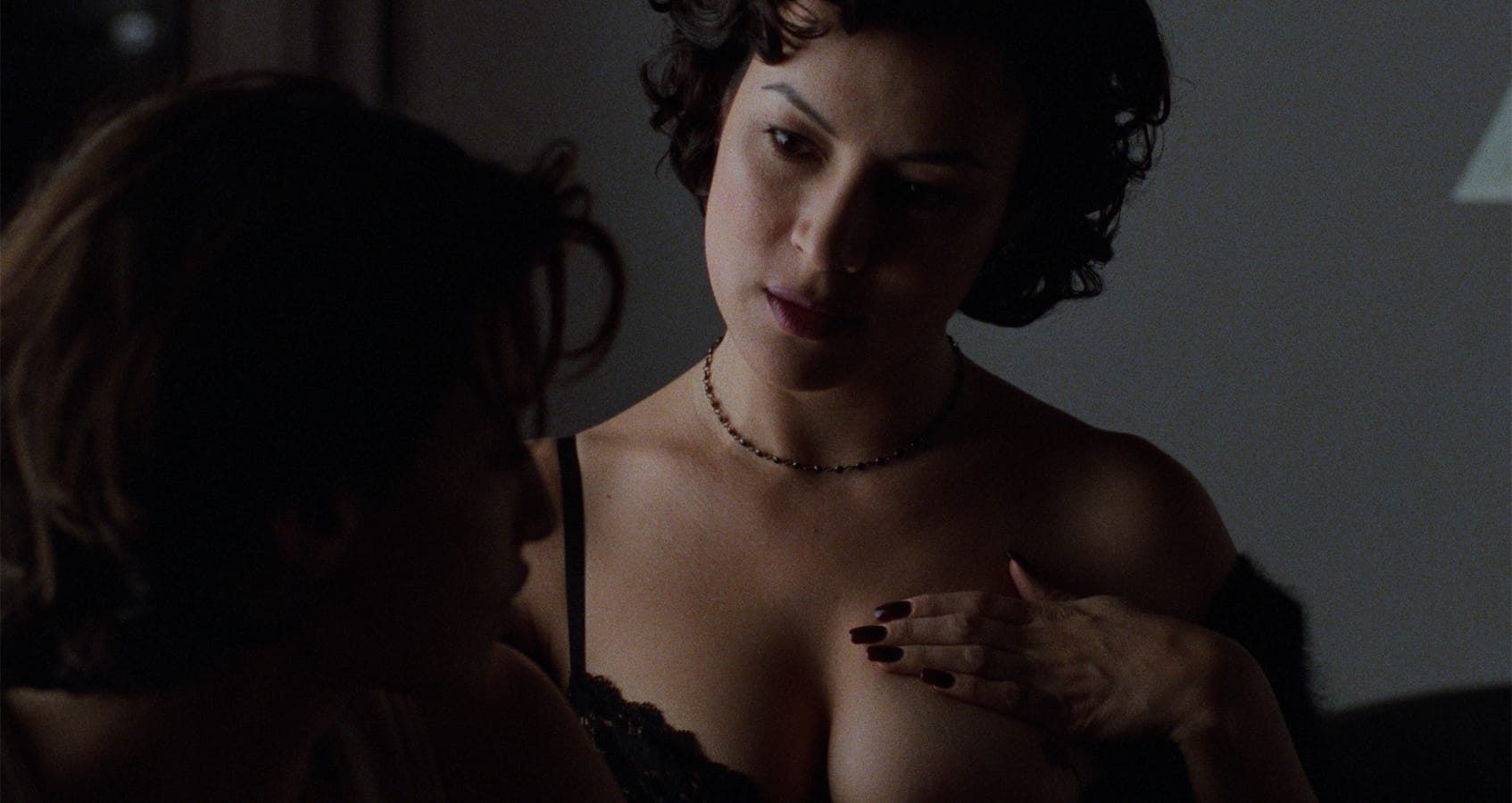
Bound is a movie wound tight with something paradigm-altering about to break through: it is the Wachowskis’ directorial debut, followed up by a little flick called The Matrix in 1999. “Watching it again now, I think of Bound as an allegory of its own making,” says McKenzie Wark, a professor of culture and media, in her essay for the Criterion blu-ray. “Violet and Corky are not exactly Lilly and Lana Wachowski, but the mob makes a pretty good stand-in for the film business. Our heroines bring together the tools of making and believing to produce a lucrative work of make-believe. The success of Bound set them up for a lifetime of cinematic adventures. They got away with it.”
Bound doesn’t have the same makings of a worldwide phenomenon as The Matrix, but it certainly proved the Wachowskis to be skilled artists, with its examples of their signature aesthetics and thematics. Bound, too, is disturbingly pristine, thoughtfully subversive, and very queer. The story: after five years in prison for “redistribution of wealth,” Corky (Gina Gershon) has picked up a job renovating an apartment and stepping in as a handywoman when needed. Following an electric meeting in the elevator, Corky begins an affair with Violet (Jennifer Tilly), a woman who lives in the building with her low-ranking mobster boyfriend Caesar (Joe Pantoliano).
Violet and Corky are still exploring the contours of their steamy relationship when Caesar is tasked with handing off recently reclaimed embezzled money to his boss (Richard C. Sarafian). Violet daringly proposes that she and Corky steal the money, and Caesar will run for his life, marking him as the thief. But when Caesar stays to fight his way out of this, they are embroiled in a claustrophobic, stress-inducing plot. Violet tries to inconspicuously redirect Caesar back to a plan that benefits her while Corky listens closely through the (thin) walls. The bulk of the action takes place within the sleek apartment building, where things are ordered and sinister. Or at least this is the case for Caesar’s apartment; the apartment that Corky is fixing up has softer decor, serving as an alternative space.
The cinematography elevates the setting, with smooth shots looking down on henchmen marching through the walls and Violet or Corky trying to escape their confines. The world of Bound is of hierarchy, luxury built on corrupt practices, and so many noir and gangster movie tropes. Hell, even Caesar can comprehend the trope of the mobster coming home to find his girlfriend cheating him. However, when this happens early in the runtime, he quickly assumes he was mistaken when he realizes the person wearing a muscle tank sitting in his living room is a woman.
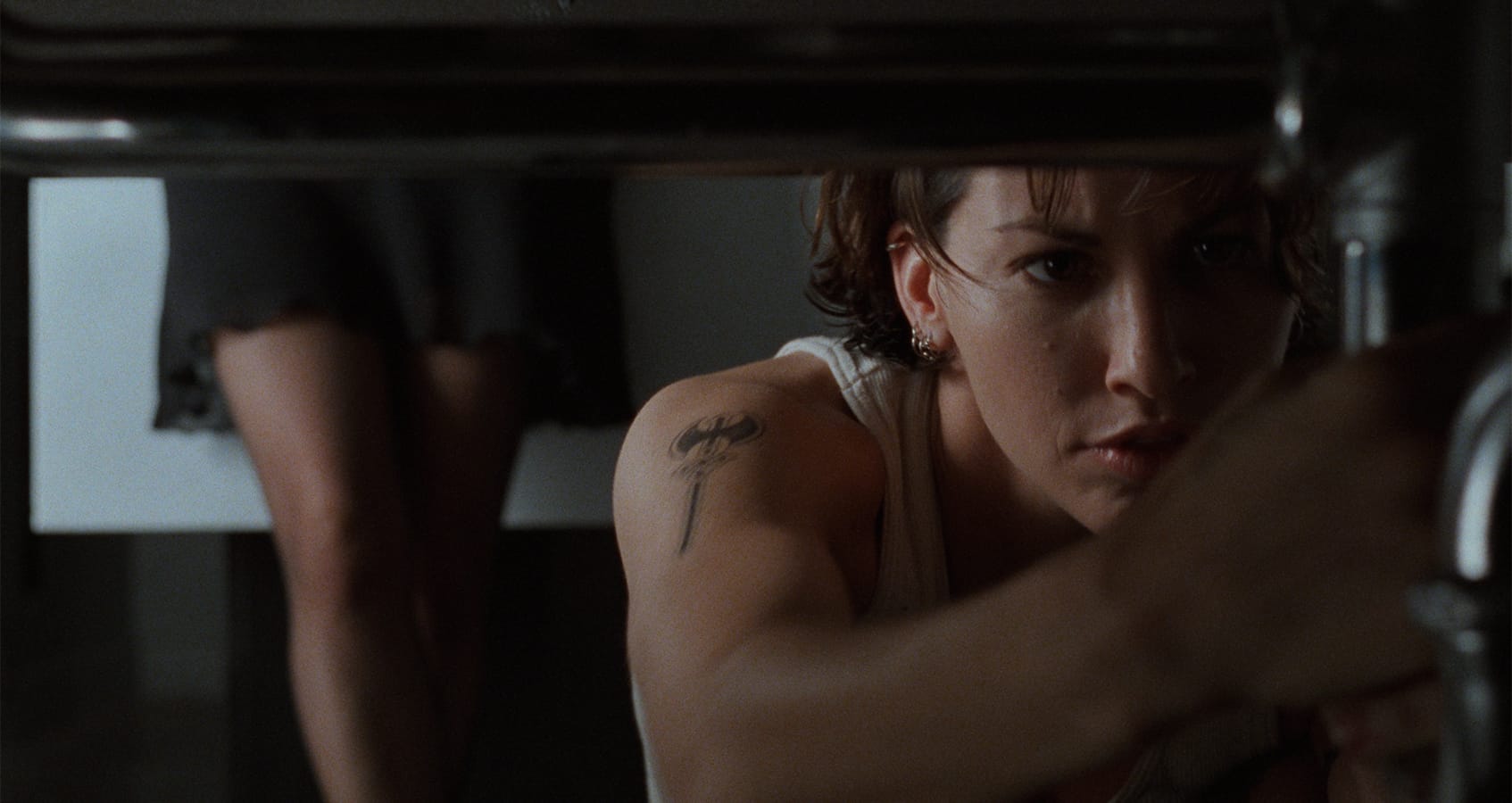
Existing in this reality, Corky and Violet are deliciously transgressive. Some more moments of great cinematography highlight their pleasure and resolve to escape together. The movie’s true main character is arguably the smoldering chemistry between them. Tilly gives a sultry femme performance that is brilliant in its delighted self-awareness, while Corky is curt and insightful. “If there’s one thing I can’t stand, it’s a woman apologizing for wanting sex,” she says. (Violet is, importantly, not apologizing for getting Violet into her apartment with the excuse of having dropped an earring down the sink drain).
One thematic pillar upon which the story rests is queer women getting what they want; the other is “the business” of it all. Violet and Corky dance around each other, they talk about trust and allude to the reasons they both have to cut and run, taking the $2 million and leaving the other to deal with the consequences. More words to live by from Corky: “For me, stealing’s always been a lot like sex. Two people who want the same thing: they get in a room, they talk about it. They start to plan. It’s kind of like flirting. The only difference is, I can fuck someone I’ve just met. But to steal. I need to know someone like I know myself.”
But it’s actually Caesar who uses the phrase “the business,” talking about his work and demonstrating the theme’s wider applicability. In addition to Corky and Violet “getting in a room” to have sex and plan their heist, all the characters are brought to the enclosed space of the building to figure out, one way or another, who will claim the prize. Additionally, the triangle of Corky, Violet, and Caesar contrasts Violet and Caesar’s relationship with Violet and Corky’s relationship. As the plot thickens, Caesar plays the victim, demanding to know how Violet could betray him. She responds that it was always business between them; they both got something out of it.
30 years have passed since Bound had its world premiere at the Venice International Film Festival. A lot has happened, including both of the Wachowskis coming out publicly as trans women, which has only made the film’s trailblazing nature more so. McKenzie also argues that “It’s tempting to reinscribe an essentialist reading, and see Bound as a trans film now because it was made by trans filmmakers. Or we could think of transness in cinema a little more expansively.” More than once in their shared career, the Wachowskis would confront executives who wouldn’t want them to include explicitly trans or queer characters in their films—but even when they lost the battle, their intent came across.
Bound masters the pacing conventions of the type of movie it is, but is sexy and mysterious in a way that was revolutionary then and still insurgent today. “Bound is an invitation to sense differently,” says McKenzie. “Violet asks Corky to verify what Corky sees and hears through touch, through taste, to trust Violet’s desire.” Yet for all its debauchery and violence, Bound hinges on strikingly pure motives. While Violet and Corky could be cold pragmatists and leave one another behind, they simply don’t. This is a story where two women meet, form a genuine connection, and decide to fight for each other—and thus, their path to freedom lies in their bond.
Bound
1996
dir. Lana & Lilly Wachowski
105 min.
Screens Tuesday, 6/23, 8:15pm @ Brattle Theatre
Double feature w/ Desert Hearts
Part of the repertory series: Wicked Queer presents Pride Celebration