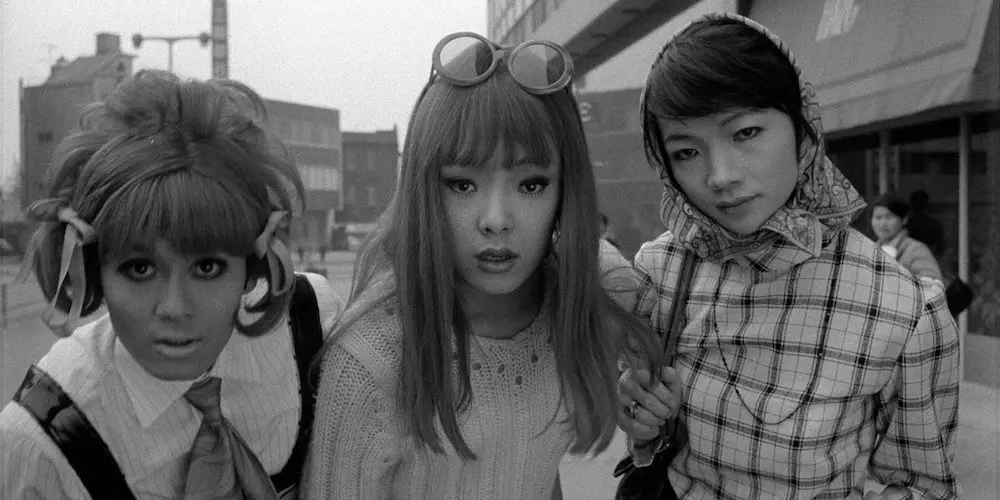
Funeral Parade of Roses is an experimental, non-linear narrative/documentary hybrid about gay and trans life in 1960s Tokyo and the underground film culture of the time. It roughly follows Eddie (Peter), a transgender woman and other hosts/performers (called “gei boi”) as they get by working at Genet, a gay bar with intimacy services. Eddie sleeps with Gonda (Yoshio Tochiya), a drug dealer who runs Genet and lives with the current lead girl of the bar, Leda (Osamu Ogasawara). Promising that he wants Gonda to replace Leda as Genet’s madame, Gonda prompts a jealous spout between Eddie and the supposedly in-love Leda, who really only uses him for job security and assurance of her un-transitioned transgender identity as a woman. Beyond the club, Eddie lives her life—she her time with a group of underground film-obsessed potheads led by the long-bearded, wise-looking Guevara (Toyosaburo Uchiyama), goes shopping with friends, and hooks up with some men whilst dodging more aggressive ones—trying to contend with her own identity and troublingly stabby past. With shocking intertitles to keep viewers vulnerable and interviews to ground in-film happenings in reality, Eddie, Leda, and some other cross-dressing gay men or trans women demonstrate the wide range of cruelties/transgressions that bleed into their and other queer people’s lives.
If any of the above sounds straightforward, it shouldn’t, and that’s for the best. Being part of the Angura film movement, Funeral reflects the complex relationships and experiences queer Japanese people face not just with its Oedipal Eddie-centered story, but with in-film interviews with its non-actor stars and others; experimental film techniques adding visual charge to an already morose center; various demonstrations of how queerness is just the same human need and desire for love, connection, and self-respect that everyone else has; and how societal or interpersonal expectations, trauma, and degrading circumstance get in these people’s way. Director Toshio Matsumoto throws viewers into the thick of Japanese underground/queer chaos, using the discomforts of poverty, sex, self-loathing, jealousy, and the culturally imposed secrecy of it all with as much filmic rawness to equal this Funeral Parade’s emotional gravity.
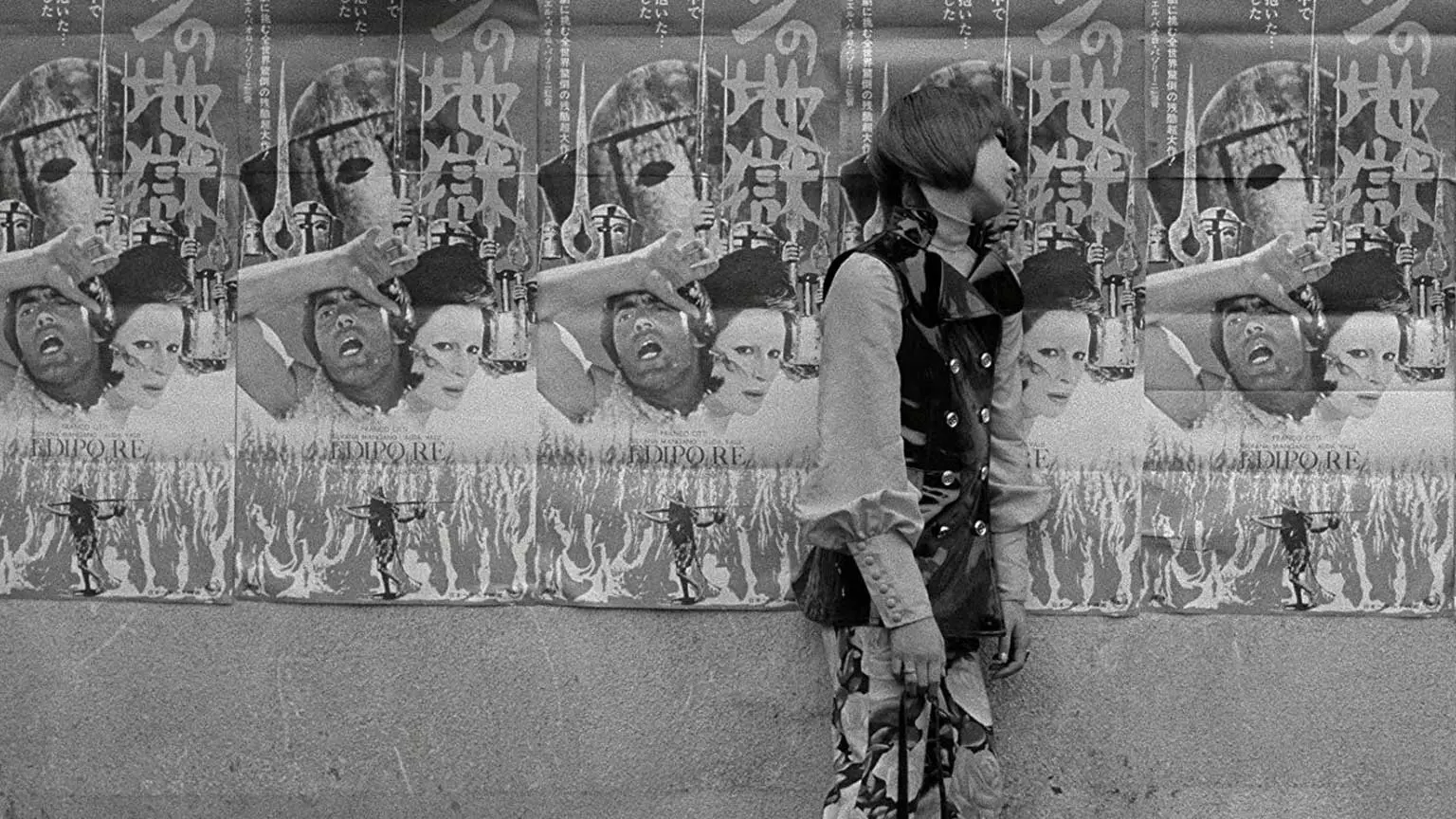
Funeral Parade of Roses distorts time with time, so that the ambivalence of its starring characters feels unbound by a clock—and so the shock of Eddie’s unbeknownst Oedipus complex and Funeral’s self-destructive end feel more like mere echoes in the rest of the Parade’s sorrow limpness. Nothing chronologically clicks together, necessarily; whether Eddie dances high as a kite with the underground group, Leda pleads to Gonda about his love and her Genet position, or various intertitles bend reality or shock one’s system, Funeral Parade demonstrates that the grayness of its subjects’ lives is also the only consistent part of it. Captured on black-and-white and often in rushed circumstances given Matsumoto and co. never attained proper shooting permits, nothing about the film or these people’s lives feels certain. Everyone in Funeral’s Tokyo lives in a state of ambivalence about themselves, their relationships, and the various worlds they inhabit. Time can do whatever it wants, as Matsumoto’s de- and reconstruction of it changes nothing about these bleak lives or the ugly gray skyscrapers and residences surrounding them. In fact, such distortion only enhances these depressing qualities.
As Eddie’s Oedipus Complex inversion slowly unravels, intimacy, jealousy, instability, and dramas about the rest of life seem to comfort the characters while intentionally discomforting viewers. When Eddie stumbles into an art exhibit of differing masks to escape some pushy catcallers, for example, and a narrator discusses masks’ abstract application to the human condition—”The subject of love and hatred, therefore, may be the masks. Under those masks, people try to escape their loneliness…, creat[ing] even more sophisticated masks” for others to accept—she merely reflects on a reality she already lives. Eddie and the rest of the hostesses live behind several masks, whether for interpersonal (sexuality, gender, self-image) or social (expectations, impressions, dynamics) reasons, hiding themselves to get paychecks, be accepted, or just feel something. Combined with extreme close-ups of sex or characters’ facial expressions in mirrors, nightmares, and reality, these masks appear increasingly ineffectual. Stemming from trauma responses—or treacherous, parent-killing pasts birthed from a lack of familial acceptance with transgender identity, as with Eddie—these masks eventually lead most characters to grisly fates at Funeral’s end, as one can only hide so long. But for queer folks in ’60s Tokyo, as even demonstrated in actual interviews, these masks also mean survival, and survival is day-to-day life when being queer of any kind is frowned upon. The nixing of morality should not be forced on those who just want to live, but when trying to live in a world where that’s the majority’s truth—that gay and trans people are as filthy as murderers—it’s hard for those very souls to live any differently. If art is beautiful and capable of detailing countless concepts, as Matsumoto demonstrates in this grand experiment, then why isn’t queerness equally lovable?
With innumerable ideas attainable from this grand experimental palette, Funeral Parade of Roses is a certifiably un-undulating watch meant to muddy one’s understanding of morals, culture, self-expression/identity, sexuality, and the parameters of film itself. While choppy pacing and heavy topics drag Funeral through slightly untimely mud, it’s predominantly a profound dive into queerness and why, like everyone else, queer people just want to be left to live. For experimental enthusiasts, indie film lovers, curiously vulnerable filmgoers, and those in need of a watch that may match the gloom of their own lives, Funeral Parade of Roses is a perspective-warping gaze at the true blurriness of socially assigned roles based on virtually pointless differences like sexuality and gender.
1969
dir. Matsumoto Toshio
105 min.
Screens in 35 mm Saturday, 5/9, 2:00 p.m. @ Harvard Film Archive
Double feature w/ LAND OF SILENCE AND DARKNESS
Ending the ongoing repertory series: Community in Cinema