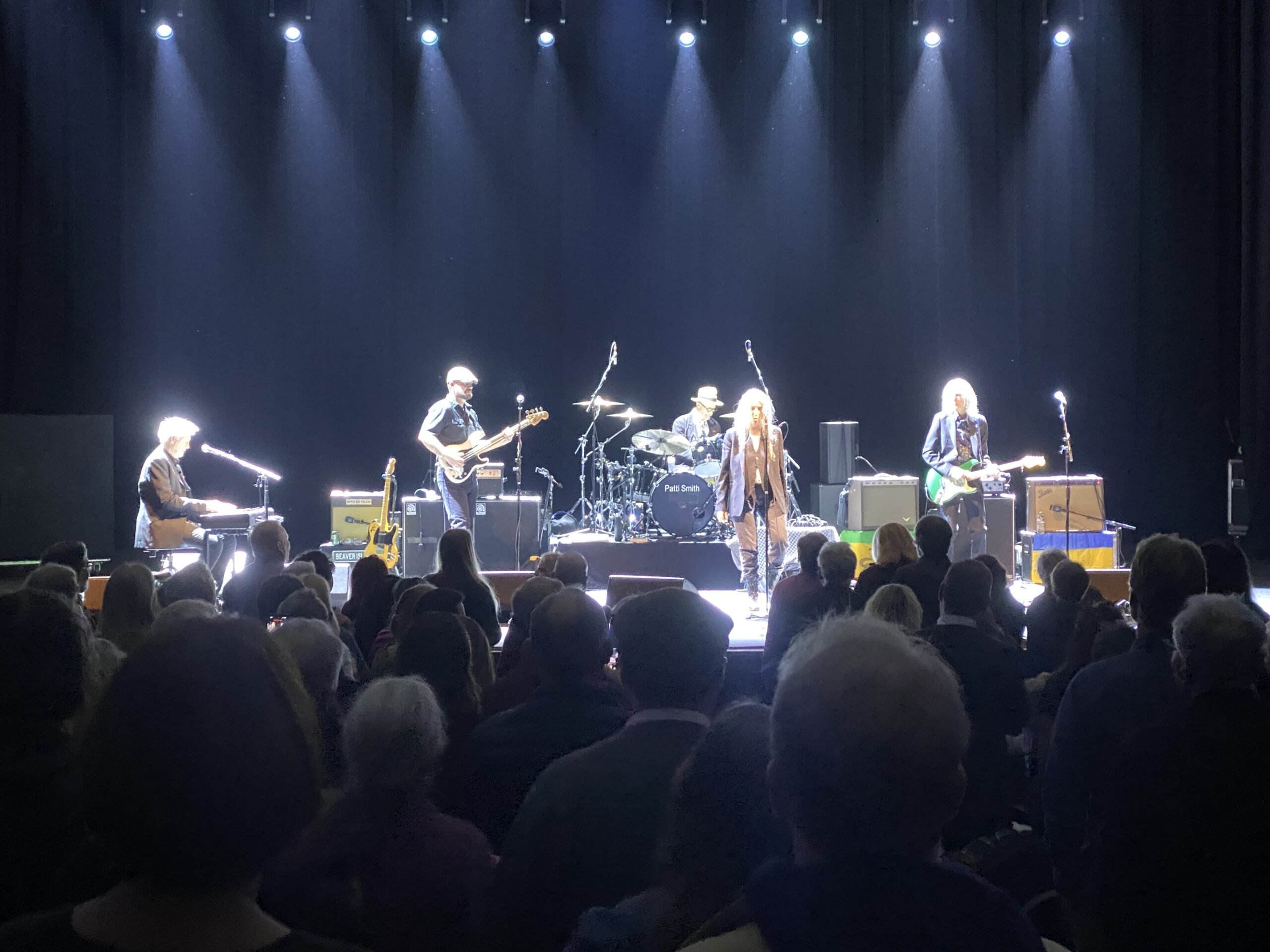
Patti Smith brought the glory that is Horses to the Orpheum on Monday night. The album is fifty years old this year, but its mix of raw nerves and mystical energy describes a vision even more desperately needed today than it was in the post-Nixon landscape of mid-1970s New York. A celebration of possibility, of optimism among despair, and most of all of transcendence, the album’s power derives in part from Smith’s willingness to bring poetry to the people. Like many of the other most literate songwriters who emerged in the second half of the twentieth century, Smith made no secret of her sources, even as she massaged them into new settings for a new world. “Kimberly” has her singing of “the bats with their baby vein faces” and “flames in a violet, violent sky,” which together echo the apocalyptic vision of the final part of T. S. Eliot’s era-defining “The Waste Land.” The monumental “Land” makes of the world of poetry and the world of rock one voice, as the Chuck Berry-esque “go Johnny go” trades the vocal spotlight with repetitions of “go Rimbaud.” Here, France’s greatest symbolist poet and America’s foundational rock and roll song run hand in hand along the sharp edge of the last half century.
Album-anniversary concerts are now something of a familiar phenomenon, and they often see performers falling into the reunion-show traps of nostalgia and self-pastiche, but Smith, unsurprisingly, avoided that danger. Indeed, she proved something that would have been more difficult to adjudge in 1975 than today: the degree to which Horses has remained essential listening even as many of its contemporaries in the vinyl bins fell into neglect. A portion of its persistent appeal derives from its historical awareness, including nods to earlier rock. Some of those, like the quotes from Chuck Berry, are matters of lyrics and performance, while others, such as the production work of John Cale, were more a matter of work behind the scenes. In 1975, Cale was less than a decade out from his tenure in the Velvet Underground, already had several production credits, and was unfolding an increasingly brilliant solo career, with 1973’s lush and languid masterpiece Paris 1919 and 1974’s equally powerful, if much more angular and fragmented, study of paranoia, Fear, most immediately in the rearview mirror. Too, Horses was eminently of the scene from which it emerged. Its release was in part made possible via an extended residency at the center of the punk scene—CBGBs—that saw Smith’s band playing every night alongside Tom Verlaine (whose adopted stage-surname is a nod to Rimbaud’s sometimes-lover, Paul Verlaine) and the rest of Television, while catching the ear of such industry figures as Clive Davis, who succeeded in getting Smith signed to Arista. Monday’s concert saw this historical situation honored by a mid-set medley of Television songs performed by the band sans Smith. Tom Verlaine may not have been able to reprise his guitar work on Smith’s “Break It Up,” but his spirit was one of several to walk the stage, and it did so no more apparently than during the three Television tunes included in the setlist.
Given the historical weight of the evening, it is not surprising that Smith was looking backwards almost much as forward. Between song stage chatter additionally revealed that “Break It Up” was inspired by a dream about Jim Morrison, and that “Elegie” was written for Jimi Hendrix, at whose Electric Ladyland studio Horses was recorded. Other tunes in the setlist were likewise tied to particular times or personalities, including several nods to Smith’s husband Fred “Sonic” Smith, but most notably in the dedication of the relative rarity “Ain’t It Strange” to the late Jimmy Cliff, who died earlier on Monday. That tune was stretched out and its reggae inflections emphasized for what was perhaps the most engaging performance of the evening, after Horses itself.
The setlist was fleshed out with a variety of pieces from across Smith’s career that have been familiar parts of shows of recent years, including “Dancing Barefoot,” “Pissing in a River,” “Because the Night,” “Ghost Dance,” and “People Have the Power.” Stage chatter before and improvised lyrics during some of these songs kept Smith-the-activist on display. One moment of the sort saw her framing a performance of “Peaceable Kingdom” as a plea for peace for the Palestinian people, and it’s notable that the last time this reviewer saw her perform the piece (in 2024, in the courtyard of the Somerset House in London), the audience reaction to that framing was quite different. That earlier performance found Smith engaging from the stage with calls for both the safety of Palestine and the liberation of Israeli hostages. On Monday night here in Boston, the former was met with resounding applause and other perspectives left unremarked. The shift in audience responses, across both time and space, can be read as saying something about changes in geopolitical sentiment, but more notable is that Smith continues to provoke thought and action, regardless of changes in the winds of audience opinion—a testament to the conscience she brings to the stage, whatever the topic. This is not to say she was grim or dour: the evening was peppered with good humor, with Smith laughing a bit at herself for stumbling over the first line of the evening, and then again over the “misplaced Joan of Arc” in “Kimberly.” Perhaps most remarkable, despite occasional slips, was the continuing power of Smith’s voice, which remained strong across the night, even though she seemed to be nursing a minor head cold.
While this audience member at least would have welcomed performance of some more recent material, such as one of the many outstanding pieces from 2012’s Banga, it’s hard to complain overmuch about a night that brought all of Horses to the stage, and in all of its glorious fullness. That she invited long-time friend and Jamaica Plain native Patti Hudson to share in the band’s final bows cemented Smith’s connection to Boston, and the music and arts scenes that call it home.