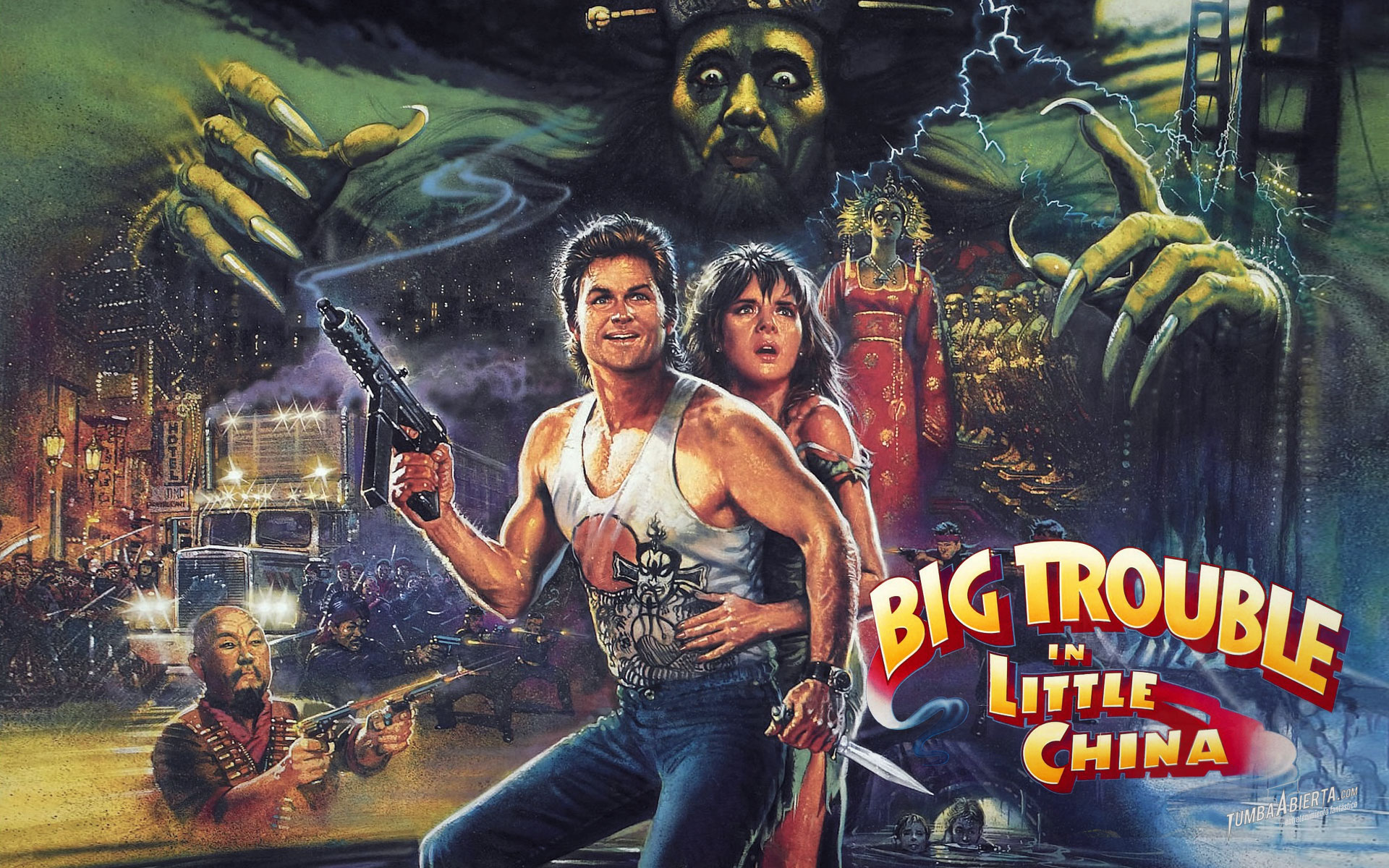
Big Trouble in Little China is a fun, fantastical, and equal parts stereotypical and subversive action-comedy film about a not-so-leading man, hotheaded-but-clumsy trucker Jack Burton (Kurt Russell), who discovers Chinese black magic in San Francisco’s Chinatown underworld. Little China follows the aforementioned ego-inflated trucker as he settles old payments with a good friend and fighter, Wang Chi (Dennis Dun). As they gamble it out and Wang loses, Jack accompanies Wang to the airport to pick up his wife, Miao Yin (Suzee Pai), to ensure his friend makes good on his payment, bumping into an equally quick-witted and un-buffoonish lawyer, Gracie Law (Kim Cattrall). However, the pair instead gets involved in a much larger criminal scheme as Miao Yin gets kidnapped by members of the Chinese-American street gang the Lords of Death in place of another girl whom Gracie was sent to protect. Now, the handsome dummy, a law expert, and a Chinese-American man just looking for a good life with his wife must battle the ultimate evil to get their loved ones back: Lo Pan (James Hong), an evil sorcerer and crime overlord of Chinatown’s many underworld businesses, his gang, and his three sorcerer underlings: Thunder (Carter Wong), Rain (Peter Kwong), and Lightning (James Pax). With help from an ancient warrior guild in the Chang Sing and a low-level sorcerer named Egg Shang (Victor Wong), Wang must get his wife back and help steal his truck back—the latter of which is far more pertinent to good ole’ Jack Burton.
Little China is a lot of fun. Wall-to-wall humor that cleverly satirizes Little China‘s serious situations without losing integrity, Kurt Russell’s aloof charm, James Hong’s cacklesome villainy, and the rest of the ensemble’s genre-bending performances create spontaneously funny and surprisingly impactful sequences. Mesmerizingly mystical sets, monsters, makeup, and costumes, a hypnotic synthesizer rock n’ roll soundtrack, and tight pacing summoned elegantly through intensive editing maintain a joyful simplicity of what is otherwise a complex wave of underworld spill-over, balancing out the viciousness and morosity of this dark underworld of bloodletting violence. As this John Carpenter-directed mashup is meant to both play into and against ’80s Orientalist action tropes (it’s still quite racist—a movie about Chinese people and culture can’t not be racist if written and directed by white guys), each star maintains a steady gate between graveness and hilarity. With every new mystical revelation of Chinese and Chinese-American culture—even if it is racistly simplified for American viewing—the characters bounce back to who they are, whether they’re idiots like Jack or level-headed, pure-hearted, and dedicated, like the film’s real leading man, Wang. In fact, this subversion and many like it are precisely what make Little China so enjoyable.
Jack Burton himself, though “he’s a man of courage” as Egg Shen says himself at the beginning of the film, is a clumsy, overconfident himbo. He thinks he’s capable of saving the day both in and out of dangerous situations, even saying as much himself: “This is Jack Burton in the Pork-Chop Express [Jack’s truck], and I’m talking to whoever’s listening out there. Like I told my last wife, I says, ‘Honey, I never drive faster than I can see. Besides that, it’s all in the reflexes.” But when thrust into danger, he’s far from perfect. He barely knows how to use guns; in the final battle, he knocks himself out for a good chunk of it; at one point, after shooting and killing one of Lo Pan’s goons, eyes widened and mouth agape, it becomes clear Jack hasn’t killed anyone before. While he remains a supporter and main character, it becomes increasingly clear that Wang is the man experiencing all the protagonist’s qualms. His wife was kidnapped, not Jack’s; he became indebted to Jack; he has extensive knowledge of Chinatown and its many gangs; and he’s the one whose reasoning for fighting evil is legitimate. Meanwhile, “I just want my truck back,” Jack pleads often. With Dennis Dun delivering a sturdy performance as the emboldened hero of this journey, such subversion adds a layer of effective unpredictability that is unusual in most films.
Unfortunately, there are also many simple components that filmmakers overlooked. None of the characters develop. Sure, they’re all introduced pretty solidly—Jack drives into view talking to no one over the radio about how great he is, Wang gets thrown into a breakneck paced gambling match, and so on—but they experience no change. Perhaps that’s the very point; even with all the aforementioned subversions, Little China remains a big studio American action film. But more emphasis on how Chinatown’s underworld affected the main characters, and less emphasis on exploring the white imaginings of Chinese culture, would’ve made Little China much more of a Big Trouble than it is.
Thus, while the unbaked characters, a thin plot, and gimmicky cultural depictions still hold this Carpenter piece back from breaking as much ground as it could, Big Trouble in Little China lives up to its title with massively laughable swings and more clever subversions than egregious stereotypes. It’s a shame this film came to be a commercial dud due to bad timing (it was released 16 days before James Cameron’s Aliens), because even now, for Carpenter fans, fantasy/action/comedy/monster/magic film fans, and fans of the cast or Kung Fu movies will find much to laugh at and love here.
1986
dir. John Carpenter
99 min.
Screens Monday, 7/7, 6:30 p.m. @ The Brattle Theatre
Double feature w/ The Adventures of Buckaroo Banzai Across the Eighth Dimension (screening 4:15 & 8:45)
Part of the ongoing repertory series: Spawn of Jaws: Blockbusters & Wannabe Blockbusters