I’m no stranger to indulging in great actors performing in bad movies. (Milla Jovovich is one of my favorite actors, for crying out loud!) Watching Saoirse Ronan in The Outrun, though, is another breed of disaster voyeurism. I want to be graceful. And I genuinely hope to see the best version of every movie I sit down to see; this is something I’ve learned from fellow critic and movie lover Zaki Hasan, and it’s a lesson that has helped me to enjoy films that a more impatient viewing would have turned me away from. But even if I squint with every judgmental muscle in my body, I still don’t know what Ronan saw in the script of her newest film. The Outrun offers little more than insufferable Oscar bait (the based on a true story kind) about alcoholism only mildly sheltered by the charisma of a great screen talent.
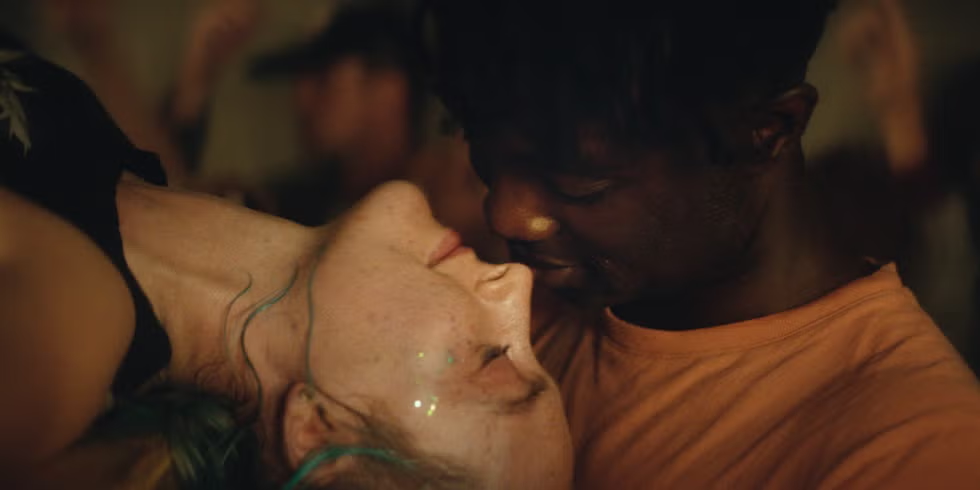
Rona (Ronan) is a pitiful woman with an alcohol addiction. Her sickness is ruining her life, and we watch her run her relationships into the ground as she drinks herself into a low. The script, from Nora Fingscheidt and Amy Liptrot, the latter of whom wrote the memoir the book adapts, moves in and out of time, and this decision is just about the only thing other than Ronan that salvages something from the film. (It also hurts it. More on this later). In one timeline, she falls in love with a man (Paapa Essiedu); in the next, she causes him physical and emotional harm in her drunkenness and he prepares to leave her, no longer able to tolerate her destructive outbursts. Her physical appearance — on a sliding scale from elegant to fucked up — pinpoints where in her recovery process we are at a given moment and where in the timeline a scene falls.
More than a few of these incidents are stitched across with grandiose and adjective-heavy Barnes & Noble-style narrative poetry from Rona: “My body is a continent. My breath pushes the clouds across the sky. And the waves roll into the shore in time with my beating heart.” Sure, she takes agency in the analogy (and by creating the poetic lines in the first place), and even though that purpose is easy enough to see, her words have the same sort of shallow meaning as a prayer at a political convention: the idea of the prayer (or “opening intention”) is what’s meant to be moving; not the prayer or the orientation itself. I’m not sure how such hollow lines could make it to the final cut, and I’m afraid the only answer is even more off-putting: the filmmakers devoured that English-major prose right up and they think their feel-good primed Academy fashioned audience will too. Even if I’m being harsh on what’s ultimately an opinion on the aesthetic of her spoken word poetry (if that’s even the right categorization of her narration), the words she chooses have an amateurish import to them characterized by metaphor and exaggeration and I’ve been in enough creative writing courses to find that type of writing unbearable. And judging by the reviews so far, it looks like they are right and I’m in the minority.
The instigating incident for her seeking help involves a night of booze gone wrong. The scene reminded me of the reason I didn’t like All of Us Strangers, a film that the majority of North American cinephilia adored despite its deeply troubling vision of love. Rona, after a long night out, can barely stand straight. She’s clearly in no position to make judgemental calls of any kind, including discerning who she can trust or not. She gets in the wrong man’s car and the man viciously beats her and attempts to rape her. The film’s anachronistic structure suggests this was the final straw; this is the reason she must clean up her life, throw the wine bottles away, and get herself to Alcoholics Anonymous.
Rona is right to sober up and only an idiot would argue otherwise — and the real “Rona,” Amy Liptrot, was and should have been empowered to see a new path for her life at any moment. All of this is true. At the same time, the storytelling devices employed by the director and the atypical structure shifts the blame onto Rona for her attempted rapist’s actions; “If you weren’t a drunk, you wouldn’t have been assaulted,” one can almost hear the Reddit boys attacking her. Yes, alcohol impairs one’s ability to make critical judgments and potentially even to consent but there were plenty of reasons Rona could have had to choose sobriety. Yunus Roy Imer shoots the scene like the rest of the film: handheld, up-close, and with a hyper-focus on Rona. The camera barely catches her assailant’s face. The scene records the moment like a disturbed memory — a preferred mode of visual storytelling for the cinematic adaptation of memoirs. The narrow focus does not responsibly account for her being taken advantage of and rather puts the viewer into her drunkenness, her impairedness; the result is a camera that reinforces that her blood alcohol content is the problem instead of the man imposing himself onto her.
The Outrun
2024
dir. Nora Fingscheidt
117 mins.
Now playing @ Kendall Square Cinema and AMC Boston Common.
Joshua Polanski is a freelance film and culture writer who writes regularly for the Boston Hassle and In Review Online. He has contributed to the Bay Area Reporter, Off Screen, and DMovies amongst other places. His interests include the technical elements of filmmaking & exhibition, slow & digital cinemas, cinematic sexuality, as well as Eastern and Northern European, East Asian, & Middle Eastern film.

The “need” for alcohol doesn’t ever “come out of nowhere”; if we need to be human persons, we have need of interpersonal intimacies. If our past traditions seem to no longer provide these in any sufficiency and/or safety, we can only try to reinvent how we relate to a greater world around us which no human could ever have invented. Thus we are caught, somewhere, between the “natural world” which promises health, and the regiments of competing man-made artifices available for use everywhere. In either case, the victim must fall back on having to learn how to relate to themself first. For the law of personhood is the law of g r o w t h. Thank you.