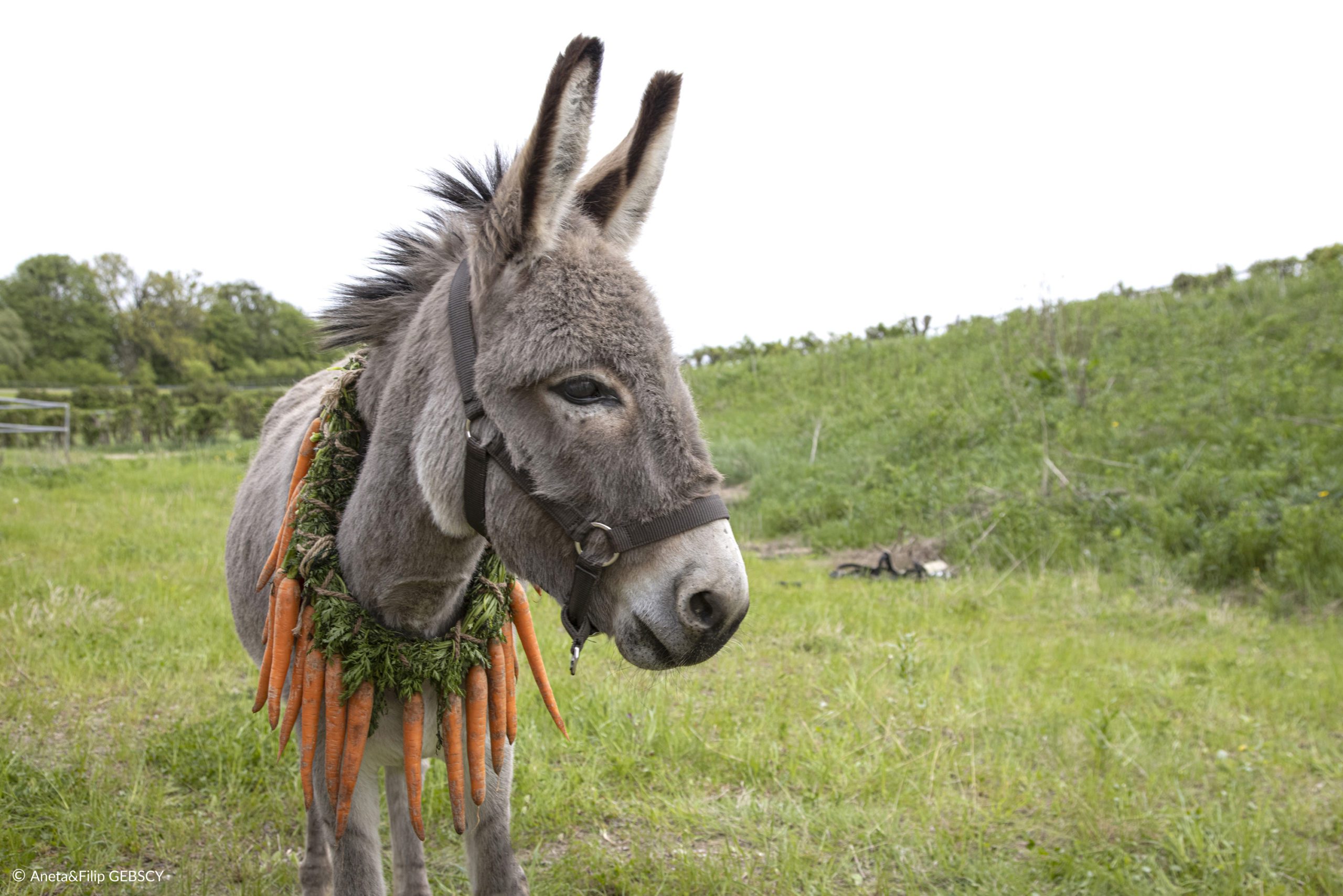
For his adaptation of Robert Bresson’s Au hasard Balthazar (1966), Jerzy Skolimowski replaces France with Poland, the 1960s with the 2020s, and austere, tragic beauty with profound weirdness. EO follows the misadventures of an eponymous donkey. Following a career as a circus performer, our hero continually changes hands, prey to the whims of fate and the kindness or cruelty of humans. Though it progresses chronologically, the film has little semblance of a narrative arc. Instead, it presents a rangy map of encounters, punctuated by sharp moments of surprise. Be it a benign exchange between strangers that takes a violent turn, or Isabelle Huppert’s appearance as an aristocrat hot for her 20-something stepson, these bizarre, unexpected moments indicate an absurdist worldview. Befitting the titular “au hasard” of the movie’s forebear, randomness is EO’s guiding logic as it sketches a world with no clear patterns of meaning.
Like Balthazar, EO exposes the motives and behaviors of a cross-section of society he meets in his travels. But beyond this passive role, Skolimowski gives his donkey a measure of personhood. Two dramatic dream sequences sweep EO into the past, when he basked in the love of fellow circus performer Magda (Sandra Drzymalska). These scenes are laced with a romantic longing that points to EO’s vast reserves of emotion, eternally incompatible with his physical subordination. The movie also positions EO as a piece of low technology. Skolimowski films modern tools like cranes, wind turbines, and robots with sweeping camera movements, emphasizing their industrial powers which far outsize EO’s. What use does a humble donkey have in this landscape? Dogs, horses, ants, spiders, owls, foxes: the other creatures that populate the world of EO are commodified or socialized by humans, or entirely independent of them. The domesticated yet undesirable donkey is left in a precarious position, with no clear place in civilization nor the wild.
Donkeys have extraordinary symbolic value in Christianity; you don’t carry Jesus to Jerusalem on Palm Sunday without earning some spiritual cachet. This, combined with Bresson’s reputation as a Catholic filmmaker, makes a Christian reading of Au hasard Balthazar inescapable; Balthazar becomes a proxy for Christ, absorbing the sins of mankind. EO does not quite comply with this allegory, in part because of its unusual stylistic approach. Bresson expressed his faith through a transcendental style that downplays the personality of the director in favor of a spare, sober, economical strategy. Skolimowski, however, does not fear ostentation. He delivers a number of conspicuous flourishes: he warps the film’s visual and aural perspective to represent that of a donkey, sends the camera flying through the air in grand circular motions, and drenches the screen with red. He also applies a secular treatment to the movie’s finale. While the audience witnesses Balthazar die of a gunshot wound, EO’s death is anonymized. It is not exceptional or made holy by stigmata: he goes the same way that millions of animals do every day. Skolimowski also alienates the audience from the event itself; a cut brutally separates us from emotional catharsis. It’s a strange irony that in a film underpinned by the unpredictable nature of life, death should feel so inevitable.
EO
2022
dir. Jerzy Skolimowski
96 min.
Part of the 60th New York Film Festival – click here to catch up with the rest of the Hassle’s fest coverage!