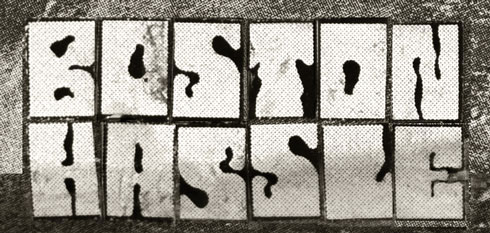
Special premiere screening as part of the Brattle’s Reel Music Film Festival! Exciting!
The way I remember it, in the beginning, Cocteau Twins were entirely sui generis: no one sounded remotely like them. The beginning for me was sometime in the late summer of 1988, when my then (and new, and first) girlfriend demonstrated a dance she’d been working on. Transfixed as I’m sure I must have been by her dancing, what affected me most was her choice of soundtrack — gossamer, ethereal, dreamlike yet urgent, with incomprehensible, acrobatic vocals sung by what sounded like a lovesick angel. After a few years with my head buried in the Sixties, “Lorelei” woke me up to the existence of a refreshingly novel, alien iteration of psychedelia. I instantly fell in love.
A few months later, and with the same sense of excited wonder, I heard Sonic Youth for the first time courtesy of MTV’s 120 Minutes (a show for which I would soon pretend to be too cool; so, by way of belated amends: thank you, 120 Minutes, whenever you are). “Candle” coaxed me into buying Daydream Nation, commencing a lifelong fandom. But it didn’t occur to me to draw a line connecting Sonic Youth’s splintering shards of queerly-tuned dual-guitar skree to the shimmering webs of shadow and light spun by Cocteau Twins. Sure, they both made what the English music papers called “independent” rock — a parallel universe with its own charts and its own stars — but that was where the commonality ended.
Kevin Shields heard it, though. He heard the overlap between the Cocteaus’ filigreed otherness and Sonic Youth’s Branca-fication of post-punk pummel. It was in the guitars: in their super-saturated, sweetly sickening distortions; in the emotional intensity of their evocation of a variety of elsewheres; and in the spaces where beauty collides with noise. It isn’t as if no one had occupied this juncture before: The Jesus and Mary Chain’s Psychocandy alit there in 1985, and A.R. Kane (initially dubbed “the black Jesus and Mary Chain” by some) began their own eccentric excavations of the terrain in 1986. But it was Shields who put all the elements together in a way that inspired countless emulators, spawning a scene which ran parallel to grunge in the early 1990s, gathered a cult of fervent devotees, and remains enormously influential today. My Bloody Valentine were and are the heart of “shoegaze” — otherwise known as dream-pop, or “the scene that celebrates itself” (Melody Maker, RIP) — and they are at the heart of Eric Green’s new documentary, BEAUTIFUL NOISE.
Six years after its initial release-date came and went back in 2008, Green’s talk-and-clip-fest homage to shoegaze is finally landing in a theatre near us. The Brattle Theatre, to be exact. This is something you’re likely to be either very excited or completely indifferent about. For some of us, for example me, the years between 1988 and 1992 — anni mirabiles for “alternative music” by any reckoning — found their most thrilling expression in the lush, curved, slowdiving swerveride of shoegaze, with band after band emerging in rapid succession to push the sound forward, or at least somewhere slightly different. Critical consensus turned against shoegaze in time (by now the relationship is ambivalent, I’d say), but fans are forever, and this is a movie for them. Or you. Us.
Packed full of — you guessed it — clips and talking heads, there is nothing particularly experimental about BEAUTIFUL NOISE. An engaging if conventional hagio-mentary, it gathers together hordes of the expected suspects — members of Ride, My Bloody Valentine, Cocteau Twins, Jesus & Mary Chain, et much cetera — alongside such headscratch-inducing outliers as Trent Reznor and Billy Corgan, and has them talk it all out. These conversations, interspersed with concert footage and assorted other ornamentation, provide historical and personal context while also untangling influences, elucidating technics, and allowing lots of room for mutual appreciation.
I’m fairly certain that seeing My Bloody Valentine in 1992 destroyed my hearing forever. But it was worth it for the incomparably pretty tinnitus they left behind.
http://youtu.be/8x-pyfeDg-E
BEAUTIFUL NOISE (2014) dir. Eric Green
11/18 pm // 8:30pm
100 minutes
Brattle Theatre
40 Brattle St.
Cambridge, MA
02138