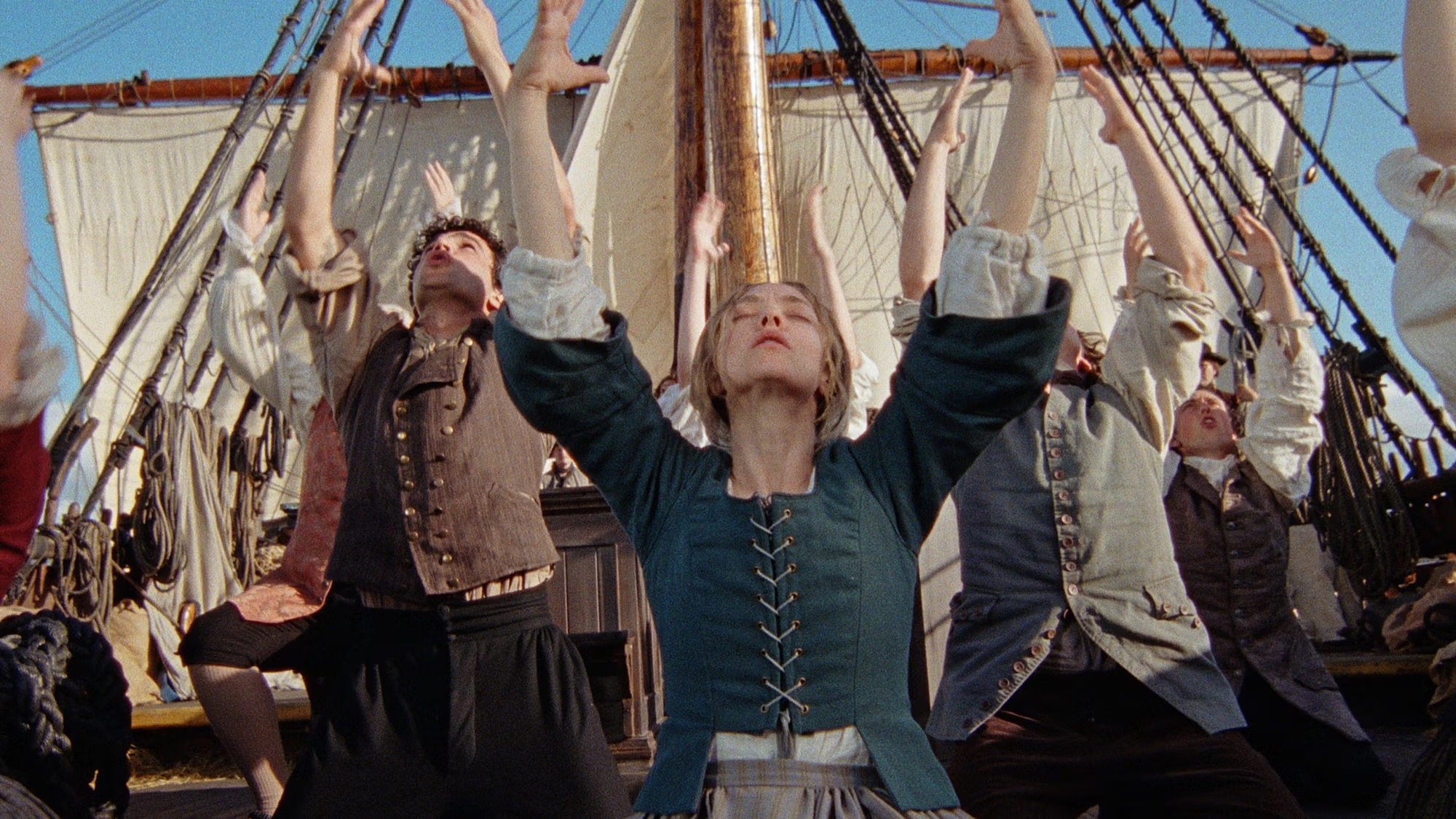
The most striking aspect of Mona Fastvold’s The Testament of Ann Lee is not its sprawling and grand musical sequences, nor the noisy, rhythmic thrumming and pounding of collective, impassioned worship, or even the ever-brilliant Amanda Seyfried. Beneath the grandeur of the project, of the legend of the Shaker movement, is the immense weight of one woman’s grief and suffering.
Much like The Brutalist (also written by Fastvold and her husband, director Brady Corbet), The Testament of Ann Lee is about the triumphs and shortcomings of an act of creation in a new place, American assimilation in all of its violence and atrocity. The Testament of Ann Lee is a historical drama and a musical, though it is entirely dissimilar from traditional movie musicals. The soundtrack is not something that begs to be streamed after the credits roll, but instead it laces itself throughout the narrative, inspired by actual Shaker hymns and embodying the rhythmic intensity of their practice.
While The Brutalist languished in rich feats of architecture and the physicality of creation, The Testament of Ann Lee introspectively studies a religious movement as a monument. The emotion and power which drive the narrative come from the outrageous musical numbers, which are as thrilling as they are entertaining. It serves as a brilliant companion piece to The Brutalist, similarly an examination of the need to build something in order to build meaning, in an attempt to justify tragedy, to make sense out of a journey. Fastvold approaches the Shaker movement with a genuine curiosity for the life of the woman who founded it, and the conviction she carried herself with. The Testament of Ann Lee never forgets the tragedies of Ann Lee’s life, the being and the suffering behind the religion. Amanda Seyfried is incredible as Lee, with her unwavering faith and strength present in every beat. She sings and prays and worships passionately, without fear or doubt.
The Testament of Ann Lee examines religion not as a fixed aspect of society, but rather as a burgeoning one. It treats the visions of Ann Lee as mystery and legend, without overt judgment, and instead respect and awe. It is the power of worship, of a collective of people striving and yelling and dancing and chanting towards creating something for the sake of creating it, which makes the Shaker movement so compelling. Fastvold’s direction takes a fringe and eccentric-seeming moment of American history and applies cinematic splendor and musicality to it. Led by an emphatic, passionate, and self-assured central performance, with incredible costuming and choreography, the film channels the wonder of early American and colonial myths, treating the history of Ann Lee like a misunderstood sonnet of New England lore. The Brutalist wondered aloud about the journey and the destination, the desire for creative fulfillment, the tension between existence and creation. I couldn’t ignore the connection between the two films, and how The Testament of Ann Lee wonders, yells, and shakes in search of that same objective. How does a movement dissolve? Is it worth it to create something which will one day fade into obscurity? Is there still meaning in that?
The Testament of Ann Lee
2025
dir. Mona Fastvold
137 min.
Now playing in 70mm @ Coolidge Corner Theatre and Somerville Theatre, and in standard digital @ Kendall Square Cinema, Alamo Drafthouse Boston Seaport, and AMC Boston Common