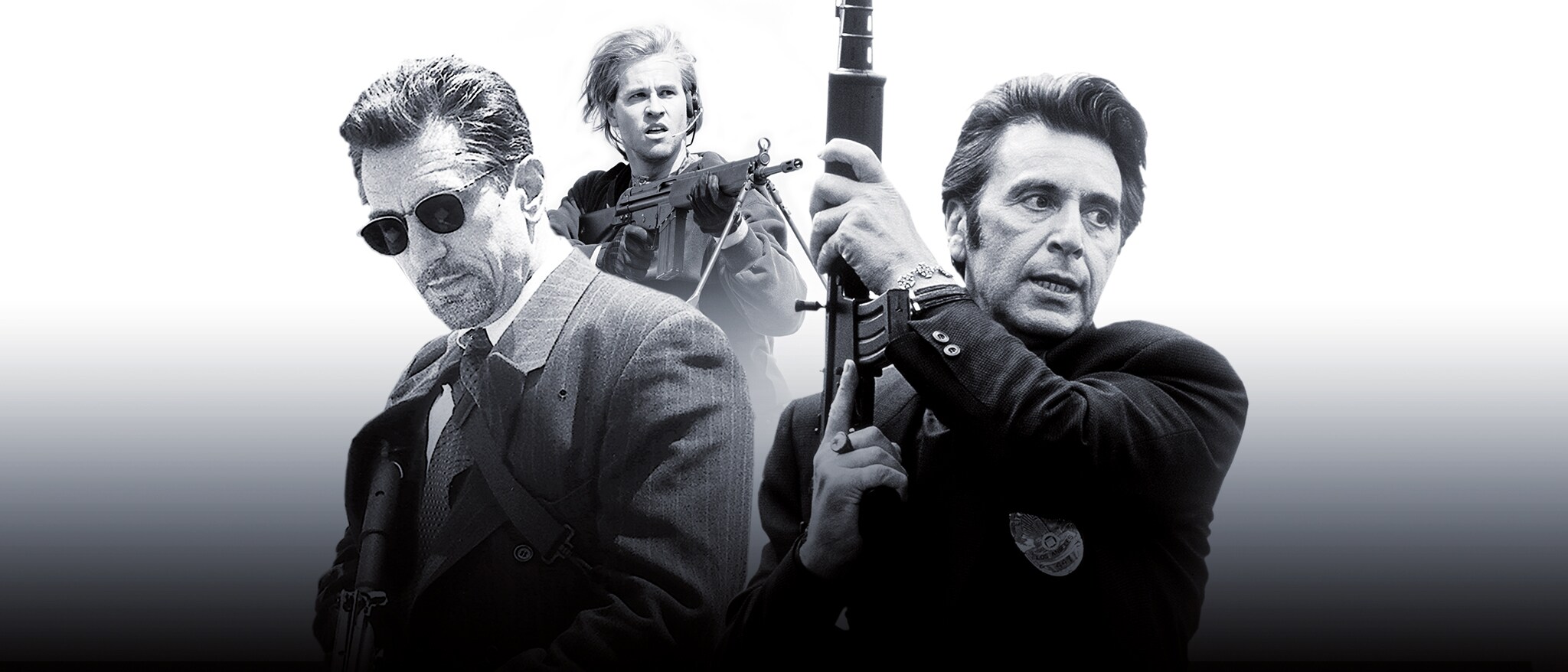
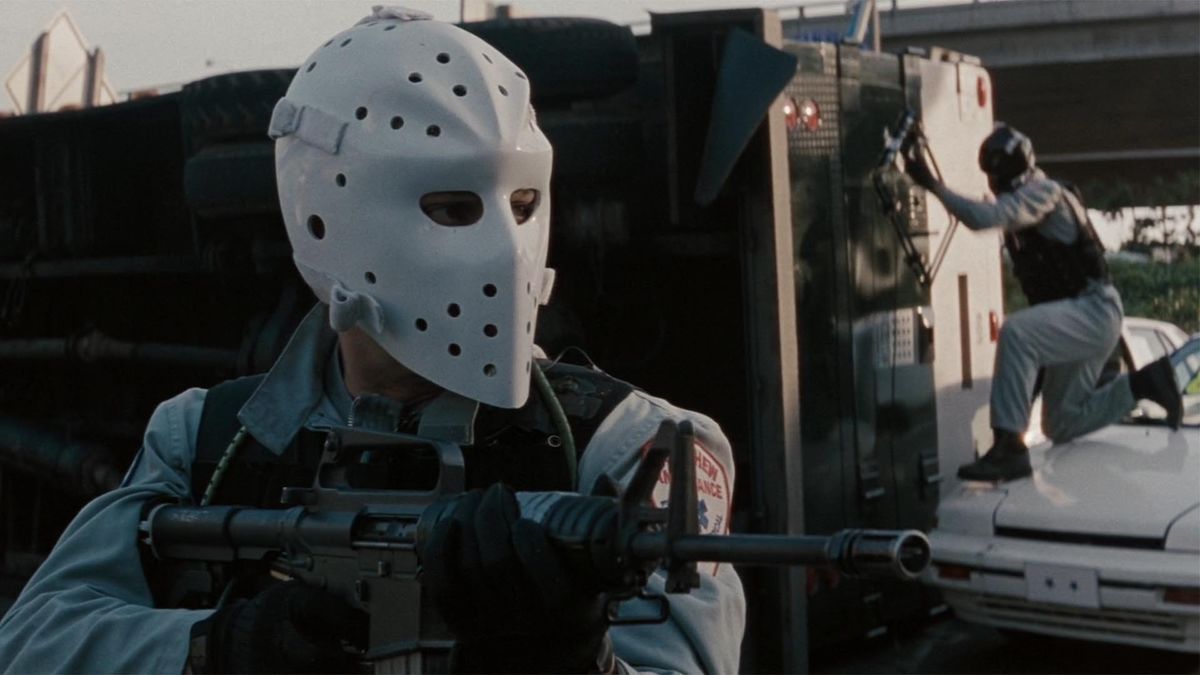
Heat is a sizzlingly detailed—if overstuffed and long-winded—action-thriller about two sides of the same coin working against each other in a complicated heist, and how their professional choices direct the rest of their lives. The film opens showing seasoned thief Neil McCauley (Robert De Niro) going about his usual business with his LA-based crew, robbing an armored car of $1.6 million bearer bonds in a Grand Theft Auto-inspiring, iconically large-scale sequence. While most of McCauley’s crew—his right-hand man Chris Shiherlis (Val Kilmer), their lethal enforcer Michael Cherrito (Tom Sizemore), and the getaway driver Gilbert Trejo (Danny Trejo)—work together well, newcomer Waingro (Kevin Gage) kills one of the guards unprovoked. While McCauley attempts to eliminate Waingro only for the reckless thief to escape, the crew discovers a new threat from Waingro’s dumb move: LAPD Police Lieutenant Vincent Hanna (Al Pacino), a dedicated-to-an-unstable-point cop and former marine who spends every waking hour among victims and their killers, now hunts them. As McCauley and co. begin planning their next heist, they quickly realize they’ve been had and cancel plans as Lt. Hanna knows their every move from years of experience.
In fact, as the film progresses and breaks into how their professions affect their personal lives, Hanna and McCauley become increasingly indistinguishable beyond their chosen professions that nevertheless complement each other (one’s always the chaser, the other always gets chased)—they’re both overly dedicated, they both struggle with finding and maintaining relationships, and they both live in existential dread partially because of their choices. Through a mesmerizingly high-stakes narrative of almost-gotchas and an introspective gaze at central characters as they balance their occupations with increasingly dysfunctional personal lives, Heat blurs the lines between morality and personal experience as the film’s characters determine what’s best for each of them individually, and whether such chases are worth the pain.
Heat has a lot to unpack. From the cast’s powerfully gritty performances and tack-sharp dialogue to the tragically relatable emotional struggle of failing relationships compounded by Heat‘s heist narrative, director-writer Michael Mann successfully pictures the devastating toll that being an experienced thief or cop harbors. Heat is the rare heist epic that showcases the near-obsessive types who get into robbing banks and stopping bank robberies to varying levels of satiating success. Through equally stubborn but differently expressed personas, De Niro as Neil and Pacino as Lt. Hanna turn their otherwise typical archetypes into disturbed, near-identical portraits of each other. For example, Lt. Hanna struggles to keep his wife, Justine (Diane Venora), and her daughter happy and remain fully present with them. Throughout the film, Justine complains about his withdrawal and how distant they are. “[You] didn’t call, didn’t show. We waited for you till 10:30.… Uh, I made dinner for us, four hours ago. Um—every time I try to maintain a consistent mood between us, you withdraw,” she explains, fingers folded yet fidgeting as she tries desperately to reach out to her husband sternly. Instead of discussing this rationally with Justine—apologizing and figuring out how they can be more open and present together—a fatigue-ridden, wide-eyed Hanna mocks her: “I got three dead bodies on a sidewalk off Venice Boulevard, Justine. I’m sorry… if the goddamn chicken… got overcooked.” His blatant refusal to self-express further deteriorates his dynamic with Justine, further deepening his dependency on his law enforcement job and chasing Neil, furthering his relationship’s end, and so on. The cycle emerges, and he’s addicted to it almost as much as the chase.
Enter Neil McCauley, a man as dedicated to his craft as Lt. Hanna, but who breaks the law instead of enforcing it. For the film’s first half, McCauley is a loner and is vocal about it: “Remember [what] Jimmy MacAwain on the yard used to say: ‘You wanna be making moves on the street? Have no attachments in your life… that you cannot walk out on in 30 seconds flat.” While he’s dedicated to making himself and his crew rich, he even clarifies to his right-hand Shiherlis how he’d do the same to any of them. He remains insistent with Lt. Hanna, too, in their brutally subtle coffee meet; as they confess recurring dreams and their unexpected respect for one another, McCauley repeats the same Jimmy MacAwain spiel, which Hanna silently agrees with in a vague half-grin. McCauley’s loneliness and Lt. Hanna’s withdrawal are thus the same reactions to the same kinds of problems. But upon seeing a bit of Shiherlis’ personal dilemma—as his wife, Charlene (Ashley Judd), threatens to leave Shiherlis over his gambling addiction—McCauley begins discovering why being alone isn’t entirely necessary. McCauley meets a woman named Eady (Amy Brenneman) and thus tries to ditch his isolated pattern.
Unfortunately, for both McCauley and Lt. Hanna, the original sentiment suits their lifestyles much better. As the chase deepens, on top of swift wide-shots of a grayed-down Los Angeles, mostly clever cut-up one-liners and sufficiently rounded side characters packed with unique assortments of racial and sexual subtext, Mann ensures that McCauley and Hanna seal their fates as much as each other’s by just being themselves. The thrill of the chase or being chased overconsumes them, as Lt. Hanna recognizes when he begs his now ex to see, “All I am is what I’m going after. I’m not what you want, Justine.” Hanna and McCauley’s exciting self-discoveries change them and remind them why they cannot change. Even as McCauley tries to get away with Eady in the end, he still ditches her at trouble’s behest; as Lt. Hanna recognizes the destructive results of his drive, he still goes after McCauley as soon as he hears he can. Michael Mann and co. thus eloquently demonstrates how easily people—and men in particular—can set themselves up for failure in this slickly layered heist film. Mental prisons are the worst, no matter the circumstances that lead to their subconscious creation.
Thus, while Heat fails to give female characters roles and depth beyond their male attachments, forty-five minutes of expositionary buildup should have been nixed, and some bits feel standoffishly corny, its painstaking attention to detail and character beats solidify it as a profound heist flick. For cast fans, heist film fans, and those looking for a deeper experience than the typical action-thriller, Heat cranks the temperature on most fronts.
1995
dir. Michael Mann
170 min.
Screens in 35 mm Thursday, 5/15, 6:00 p.m. @ The Brattle Theatre
Part of the ongoing repertory series: Kilmer Forever: Remembering Val Kilmer