
The Boston Baltic Film Festival runs from Friday, 2/28 through Sunday, 3/2 at the Emerson Paramount Center, and through 3/17 virtually. Click here for the schedule and ticket info, and watch the site for Joshua Polanski’s continuing coverage!
The following dispatch features reviews of Podnieks on Podnieks. A Witness to History; Five and a Half Love Stories in an Apartment in Vilnius, Lithuania; & Lioness.
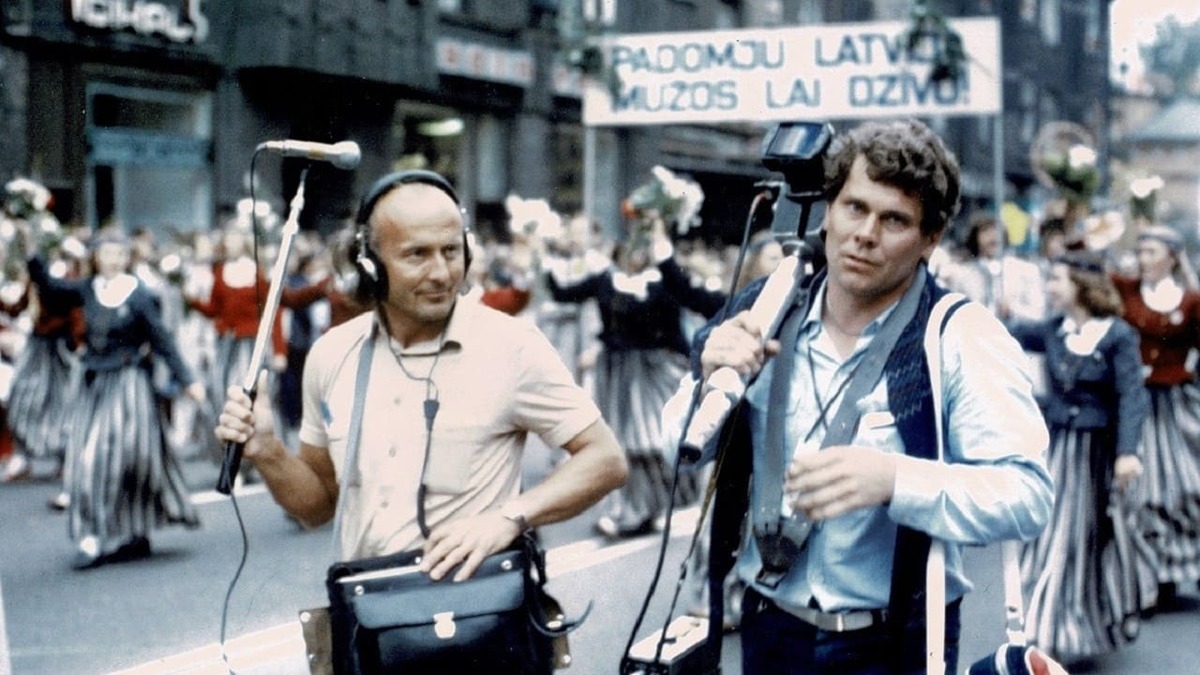
Podnieks on Podnieks. A Witness to History is the most important film playing at this year’s Boston Baltic Film Festival for the simple fact that it brings Juris Podnieks, one of the most important Baltic documentarians, and even filmmakers at large, to a North American audience for one of the first times in a cinematic focused biography. Anytime Podnieks is brought to the big screen is a win for cinema.
The Latvian Podnieks is most known for Is It Easy to Be Young?, a discursive documentary of the dissident and rebellious lives of 10 Latvian youths near the beginning of the collapse of the USSR. It was the first Latvian entry ever shown at the Cannes Film Festival and was hailed as “the first bird of perestroika” by Mikhail Gorbachev himself. The BBFF is also showing Is It Easy to Be Young? along with the two post-humous sequels in its online programming. His other key titles include a non-conformist portrait of Latvian riflemen, Constellation of Riflemen (1982), and Soviets or Hello, Do You Hear Us? (1980).
Podnieks made brave, rousing, touching, and somewhat irritable films. He could always find the best interview subjects, always vulnerable in what they shared and uncareful with how they said it. As a result of his iconoclastic filmmaking, he and his crew were constantly under the ire of the authorities and this eventually became a danger. Two of his crew members, cameramen Gvido Zvaigzne and Andris Slapins, were shot and killed on camera in a follow-up to their Homeland; that footage was used in subsequent releases of Homeland and is used again in this film. Podnieks died at just 41, an age when most filmmakers are just getting started and a mere nine months after Latvia achieved independence.
It might not even be right to call Antra Cilinska and Anna Viduleja’s film Podnieks on Podnieks a biography, since aspects of his actual life—his loves, his family, his education—are of little concern when they are not relevant to Podnieks the filmmaker. The only major aspect of his life that they witness in depth is his death in Zvirgzdu Lake in what appeared to be a scuba diving accident, though there are some conspiracy theories with alternative ideas. It might be better that way, too, since a comprehensive biography is more or less an impossible task in cinema, and perhaps best kept to literature. Podnieks was interesting because he was a uniquely talented filmmaker who came to the scene at the perfect time and captured an audience across Latvia and the USSR.
As the title indicates, Cilinska and Viduleja let Podnieks’ voice, through archival footage, interviews, and diary entries, control the narrative. His voice is not just the narrative substance; Podnieks on Podnieks largely adopts his filmmaking style too. In the film, he laments a change he observed in documentary filmmaking that forsook the truth for stylized and moody techniques. Don’t let that fool you, though: he had a style of his own, one that emphasized the freedom of his camera, the freedom of his interview subjects, and thematically the freedom of people all over the region (and beyond). He also describes his project as something of a synthesis of documentary journalism and sensual imagery, the latter being an increasingly difficult task to maintain with the national identity projects he worked on at the end of his life (Hello, Do You Hear Us?, the Homeland sequel).
The dependency on his voice does reveal his own artistic arrogance. “I have touched upon the soul of my people,” we hear him reflect. Even if true, he was a little too confident in his ability to make a good movie. Perhaps that’s because he was taken too soon, before he could continue maturing as an artist. Cilinska and Viduleja deliberated and filtered the surely countless hours of material from Podnieks’ life to distill us with the version that they did, and that’s probably because it is what Podnieks would have done too. His interviewees were as unfiltered as he is here.
Cilinska was Podnieks’s editor and one of his closest living collaborators, so she certainly knows what a Podnieks film looks and feels like. (She also filmed the two Is It Easy to Be? sequels after his death). Podnieks on Podnieks: A Witness to History tells the story of his films, their significance in the emerging Latvian national self-determination movement, and their cultural import, and there is no other way to do the trailblazing documentarian justice.

Five and a Half Love Stories in an Apartment in Vilnius, Lithuania has one of the longest titles of the festival– fitting, because it’s just as unforgettable of a film as it is a title. Tomas Vengris’s one-location anthology never meanders outside of its Airbnb in the Lithuanian capital as it follows a series of frustrated lovers. I’ve seen it a handful of times after catching its world premiere at the 27th Tallinn Black Nights Film Festival, and each time I become more fond of the film, its structure, its thoughtfully composed images, and its complicated lovers.
The vignettes supply a superb mix of comedy and heartbreak, sexiness and disturbance, intrigue and mundanity—a mix honoring the messiness of love. The guests are about as diverse as their problems: a bachelorette party, an Israeli couple investigating pre-Shoah family history, a bisexual male stripper who pretends to live in the unit to impress another man, and more.
The first story is at an Irish bachelorette party. A bachelor or bachelorette party is about as foreboding of an event imaginable in cinema with an extramarital affair being par for the course, and that’s where Meghan (Valene Kane) puts herself after sleeping with local stripper Mykolas (Marijus Mažūnas) at her sister’s bachelorette party. She’s older than everyone else at the party, and her presence feels intrusive and even gnostic as if she knows something about marriage that the younger Pollyannas will soon learn for themselves. I’m not sure what kind of person would want both their sibling and a stripper present at the same time, but that’s not a question Five and a Half needs to ask. Nor is it worth wondering how many Irish women seek out Vilnius for their bachelorette activities. What does matter is this first segment introduces sexual frustration as a theme, perhaps the guiding theme across the chapters, and the complexities of adult romantic attraction: love is never simple.
The lovers in the next episode speak Hebrew instead of English. Galia (Hadar Ratzon Rotem) and her husband Issa (Yiftach Klein) are visiting the former’s ancestral home to find information about her ancestors during the Shoah. They navigate issues of fertility and sexual incompatibility as Issa works from the Airbnb (with a loud and sexually voracious neighbor upstairs that brings out his inner-aural voyeurist) as Galia seeks larger genial-history answers. It’s also easily the funniest of the chapters. Just as some philosophers link violence and absurdity, there is also something absurd about sexuality that can quickly become hilarious when played right; Vengris exploits that capacity with ease.
There is a counting error if you look closely– or at least, it may seem that way. There is the bachelorette party, the Israelis, the lonely Hungarian man (Géza Röhrig) fighting loneliness, and the return of the stripper from the bachelorette party and a man he tries to impress with the rental (featuring a hilarious surprise appearance from an old Polish couple). If you include the transitional cleaning lady plot, Jolanta (Velta Žygure), and the man next door, that makes for five. Where is the last .5? Perhaps it is the story between Jolanta and her husband, who plays a key role at a key moment. Maybe it is the husband of Meghan from the bachelorette party or maybe it is the old Polish couple that unexpectedly found two men in their rightfully rented Airbnb? It could also be the horny and abusive couple upstairs that features most prominently in the second story.
The title is doing a lot of framing here. Beyond referencing the actual number of “love” stories showcased by the plot, it also plays with real estate marketing language of “2.5 bathrooms” and “3.5 bedrooms.” This brings commodity and exploitation into focus, themes that lurk most strongly in the second and fourth stories, as well as the occupational transitions of the cleaner (a typically lower-class profession). The fourth story, with the return of the stripper, even depends on theft and the commodification of living spaces to work in the slightest. But there’s something else going on with the title too. The “half” of the fraction reads brokenness or incompleteness into the film’s imagining of romantic encounter—and that brokenness is something all of the shorts share, even though they can also be incredibly sweet at times. The anti-romance romance also has something of an unexpected fantastical flare to it, a vibe communicated only through chapter titles and cinematography that creates a sense of perspective—as well as through the prophesied destruction of the apartment.
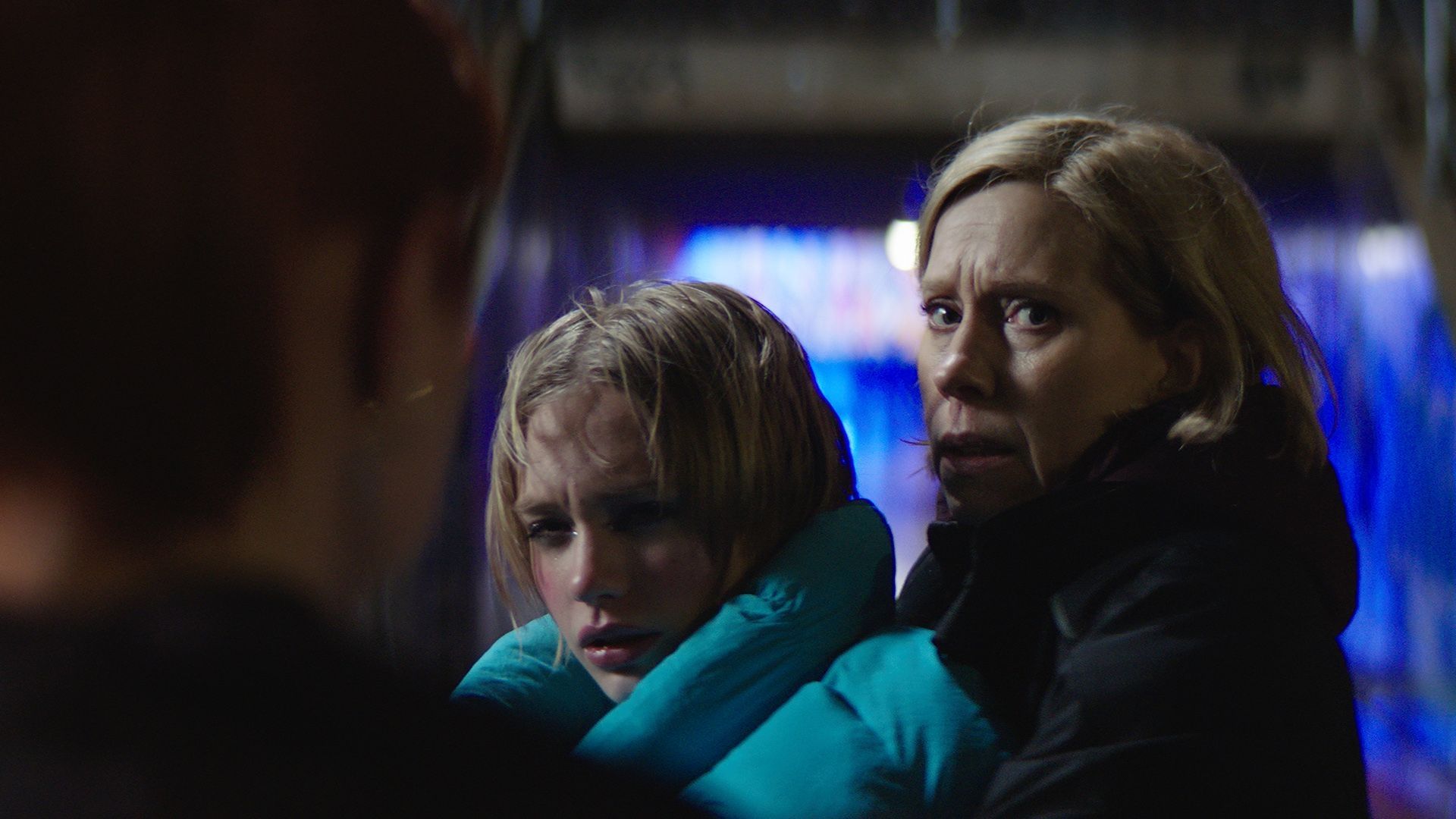
Paramedics fulfill a liminal responsibility like few other jobs. They share space with the living, the dead, and those transitioning from the first to the second. Cinematic paramedics have always leaned into this (Bringing Out the Dead being one of the most obvious examples), and Katariina Unt’s Helena in Lioness carves her position into this legacy of cinematic paramedics with an intense seriousness and efficacious regret. She exudes so much guilt with her shrugged shoulders and quiet physicality that the viewer will even feel responsible for her sins by the end.
Her regret comes not from her job as a paramedic, but from her role as a mother. Her 15-year-old daughter Stefi (Teele Piibemann) falls in with the wrong crowd and descends on a path of self-destruction involving drugs, blackmail pornography, and even worse, and Helena’s blameful eyes can only see how her mothering drove her child away. She descends into the Estonian underworld to harrow her daughter from the shadowy corridors of the city before it’s too late. The task she is up for with Stefi closer resembles her job as a paramedic—between the worlds of the living and the dead—than run-of-the-mill mothering. The crew harboring Stefi, led by the steely bad girl Mariann (Elina Masing), knows their way around the dark underbelly of the city the way a gamemaster knows their way around the board.
The picture shares a lot with Paul Schrader’s great film Hardcore, about a religious father traversing the depths of a metaphorical hell to save his daughter from an abusive sex slavery pornography system, though Schrader’s film ends up a lot more hopeful than Triškina-Vanhatalo’s feature. The characters all seem to have already fallen off the cliff; there is nothing to save them from. Grief, guilt, regret, and the psychology of loneliness and trauma also end up being more important than the spiritual concerns of Hardcore. The psychological exploration—especially the bending of reality and fiction in the minds of characters—ends up being more like Vincent Ward’s What Dreams May Come, in which Robin Williams’s Chris Nielsen saves his wife from hell. Ultimately, though, it is futile to compare this Estonian drama to anything in Hollywood; the latter is simply too fundamentally optimistic to relate to the brilliant darkness of Lioness.
A key moment in Lioness occurs around the halfway point. Stefi’s younger brother Sander (Joonas Mikk) uncharacteristically starts throwing fists at older kids in school. He won’t explain his sudden roughness to the school; as far as they are concerned, it’s a random outburst of violence. His dad successfully pries the preceding event out of him later at home: an older boy showed Sander an inappropriate and illegal recording of his sister doing things that no brother should ever see his sister doing.
Before this information is revealed to the audience, a connection has already been made between the school’s failure to care for Stefi and their new failure to keep Sander from hurting himself or others. It’s the closest the film gets to pointing a finger directly at the education system. And that seems by design. In the notes for the film provided to the BBFF, the filmmakers clarified their intent “to deeply shake the audience—to force us to rethink our education system, our mental health support structures, to urge parents to look in the mirror, and to help young people see their parents from a different perspective. We believe that loneliness and anguish need to be fought, and difficult issues don’t disappear by ignoring them. Action is required, and we take action by telling stories through film.”
No single story can capture the evidence sample size problem required to challenge systemic shortcomings, but this scene with Sander does make the issue bigger than just Stefi. And by being bigger than a single failure, Triškina-Vanhatalo approaches something much closer to a critique of a systemic failure. In the time it takes to watch Lioness, our current presidential administration is gutting the United States Department of Education in real-time—making stories like this regrettably easy to culturally translate. The path before us tragically includes many more Stefis.
Lioness
2024
dir. Liina Triškina-Vanhatalo
104 min.
Screens Sunday, 3/2, 4:05pm @ Emerson Paramount Center
Live Q&A with the filmmakers to follow
Five and a Half Love Stories in an Apartment in Vilnius, Lithuania
2024
dir. Tomas Vengris
112 min.
Screens Saturday, 3/1, 8:25pm @ Emerson Paramount Center
Director Tomas Vengris in person for live Q&A!
Podnieks on Podnieks. A Witness to History
2024
dir. Anna Viduleja and Antra Cilinska
128 min.
Screens Friday, 2/28, 6:30pm @ Emerson Paramount Center
Live Q&A with the directors to follow
Also streaming virtually from 3/3-3/17