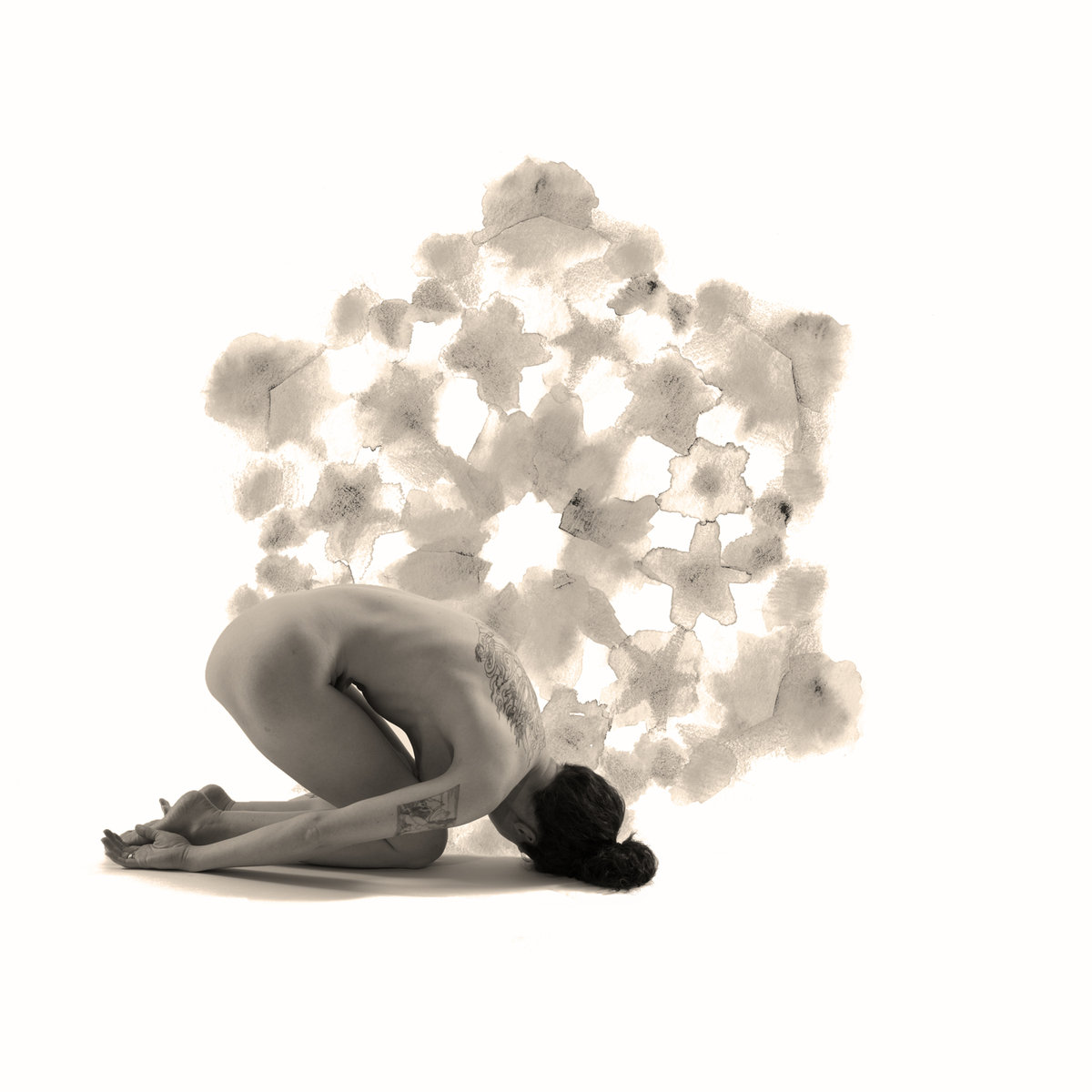
Photography by Amy Mills, Artwork/Layout by Lauren Beck.
Larkin Grimm is currently touring in advance of their newest album, Chasing an Illusion, which releases through Northern Spy Records on June 16th. They’ll also be playing a Boston Hassle show on Sunday June 18th at Studio 550, alongside Aisha Burns, Gold Dime, and Solei.
Recently, they granted me some precious pre-performance time to ask about their upcoming album, their past musical work, trauma, gender, parenthood, and the Boston music scene.
—
Pronouns for everyone in the house?
In situations in which people are open to that, we both prefer “they”. But, you know, I come from the Southeast, where people are very stuck in their ways, so I don’t make a big fuss about it.
I use “they” a lot to talk about my kid, especially the way he just loves to wear pink. He says he’s a guy, he says, “I’m a little boy”, so I’m okay with calling him “he”. But when he’s in pink, and people will say, “Oh, what a cute little girl!” I’ll use “they”, just to remind them – they haven’t told you what their identity is, so it’s polite to use “they”.
I’ve always been pretty open about my androgyny. I mean, I was talking about it in interviews in 2008, 2009. It’s nothing new. I’m a guy at home, but I really enjoy dressing in drag as a woman, when I’m up on stage.
How did you come into being a musician?
I grew up in a musical family, and we were always singing and stuff, but my dad had a lot of misogyny that he had to work through. He has now come around to believing that female-bodied people are capable of playing music. He was one of those that thought that we were just born without any rhythm –
Woah –
Yeah – like that there was a problem, that we’d never be able to do it, and he passed on his musical legacy to his older brother.
They would pick on me – “Oh, women have no rhythm”, and I’d be like, “That’s not true!” “Well, here’s the evidence – find me one woman in the band!” And, I wouldn’t really have an answer for that, because I was seven years old.
Not an age when ‘institutional misogyny’ just rolls off the tongue –
I’d be like, “We do have talent!” and my dad would be like, “I’ll show you.” and he’d play the drum solo from Wipeout, and he’d do the drum solo on the table, and he’d be like, “Okay, you do it.” And I would struggle with it because I was a little kid, and then he’d get my brother, who was three years older than me, to play it, and he’d been teaching my brother music since my brother was born. And my brother would play it perfectly, and he’d be like, “See? You just can’t do it.”
So I didn’t play any music – I listened, and I was around music constantly, but I did not play any music until I left for college.
And what was your first musical interaction in college – what was that like for you?
Well, my first instrumental interactions were that I grew up in my dad’s music store, and he would pay me a nickel to tune instruments, so all throughout my childhood, I was tuning and repairing and dusting all the instruments in the shop, mostly string instruments. So I got really into the sound of the open strings, I trained my ear, and I was droning a lot. And I would sing along to things a lot when he wasn’t listening. And I was always writing songs, since I was little, but didn’t get a lot of encouragement for it.
So, I do think I was already a musician but I just didn’t think about it. And when I was in college, I was in a sculpture program and I found a broken guitar in the garbage, and I was like – “I know how to repair this!” So I brought it into the woodshop and I fixed it up and I built it these big, hinged wooden legs, and I played it like an upright bass, and I would do this dance, with this guitar for my sculpture class.
I started building instruments in my sculpture class, and incorporating music into what I was doing, but it was never straightforward playing. It was always filtered through my art-making process. My grandmother was a really amazing painter, my mom went to art school and was a painter and photographer, and so art-making, and visual aesthetic were always encouraged, and I felt really comfortable with that.
I’ve never been that person who was going to practice my instrument alone in the room for hours and hours and hours to try to get some notes right. I can always find somebody else to do that for me, and I have more of a composer’s, or a painter’s approach to how an album sounds.
I definitely consider myself as one of those art school musicians –
– like, Kim Gordon, Talking Heads?
Yeah, yeah.
Let me ask you about your album – the process of Chasing an Illusion. Was it different from your previous albums in any significant ways for you?
There had been a number of people who I’d been playing with live, who I had never had on recordings before, and they were jazz musicians. They were people who I had found, after I moved to New York, you end up running into a lot of people who are trained as jazz musicians and I liked playing with them because I liked to improvise, and I liked to be pretty free in what I do. I don’t like to play the same song twice the same way. A lot of the people in the indie rock scene would always want to rehearse something a specific way and do it the same way every time, or they would feel uncomfortable.
From references you’ve made to Ornette Coleman, and Alice Coltrane, and Cooper-Moore, I got the impression that free jazz has been important for you, especially by these people working towards freedom and expressiveness and acceptance.
And Sun Ra as well – it’s this whole idea that you have to be an alien – to be so, so different. Those people – I mean, Alice Coltrane was not recognized in her lifetime. She worked within the context of spiritual music, devotional music, and there were a few heads who really loved her, but it wasn’t until recently that she’s gotten any recognition. Yoko Ono is also someone who’s really important to me, too. I consider her to be a free jazz musician. She was very close with Ornette Coleman.
But, Ornette got beat up, and his saxophone got thrown off a cliff for the music that he played. It was not easy for him at all.
You’ve said in the past that you wrote “A Perfect World” for a friend who was transitioning – can you talk about that song?
That was written for this trans artist, [Aeliana Nicole] who wrote this book called Parasite under her given name, Stephen Boyer, and it’s really worth reading.
She contacted me in the midst of writing this book because she wanted me to know that she were listening to my music, and she wrote about my music in the book. Basically, when she was feeling really vulnerable, that she’d listen to my music, and it would make her feel strong.
So I wrote that song, “Perfect World” for my friend, who is just a beautiful person.
I’d read this book, Parasite, to our band before we were recording – the most horrific things, because they were all such a bunch of jolly people. I’d be like, “Y’all are being way too jolly, come on! This song is dark, this is a goth record guys, this is goth!” And Martin Bisi would be like, “You are not goth -“, and I’d be like, “Yes, but, this is what I have to say in order to get you guys to the place where I want you to be.”
I’ve noticed that the way that you layer sound is really imagistic, and sculptural. You use, for example, breath in a way that feels very tangible.
The commune I grew up in was very focused on practicing healing energy work in inner cities, so I’ve practiced energy healing for a long time, and more recently Qi Gong, and there’s a sense of breath being magical to me.
A lot of this record was a collaboration with a saxophone player [Devin Waldman], and I was thinking a lot about these historic collaborations between saxophone players and vocalists, and how they learn from one another.
I was listening a lot to this band, Battle Trance, which has five saxophone players, and they basically all practice Qi Gong as well, so there’s very much this sense of an energy experience happening through the music, and I’m playing right now with a woman who’s a Reiki master, and a sound healer, and another woman who’s a Qi Gong practitioner and a sound healer. We’re all very aware of where the music hits you in your body, and what the effect is on the body.
I also have a spiritual friendship with another [saxophonist] named Sam Hillmer, and I currently play with Maria Grand, who is an absolute genius.
[Grand] and I had a lot in common in terms of dealing with trauma through our music, and she’s an incredible talent. I can’t wait to see what she does in her career. She’s just starting out and she’s absolutely brilliant.
This, by the way, is the first album of yours you’ve put out since coming forward about what happened with your producer. Can you speak to the fallout from that?
It’s really, really frustrating to me that I get labelled as angry, or just terribly wounded. People don’t seem to want to accept that I am a happy, funny person most of the time.
Even on Facebook, I recently posted a video of myself and people were like, “Oh, it’s good to see you laugh!” I was like, “Are you kidding me? You think that because I was raped eight years ago, I never laugh? Fuck you!” I was married to a comedian for six years, you know? I have lots of jokes, and I have a great sense of humor, and the way that we get through trauma is by laughing at it.
I definitely don’t consider myself to be a victim. I mean, sexual assault is the most common experience – about a quarter of women. So, just because I decide to talk about it, everything gets messed up for me? It made me kind of angry towards women who don’t talk about it.
Although, it did take me eight years to talk about it. It took me witnessing a whole bunch of women going through similar things, and realizing that that’s the only way that I saw that I was not alone. Because when it happened to me, I was deeply ashamed, and I was afraid that if I spoke about it, it would undermine my talent. People would focus on that instead of recognizing that there was artistry in my work that went deep.
Within the past few decades, DIY communities, local scenes, and broader music scenes have been reeling, trying to deal with abusers and assault in their communities. Have you encountered any scenes or individuals doing particularly good reparative work, or any kind of work to make music spaces safer for performers and audience members?
Well, I think that one of the most important things is for the men with the privilege to call each other out, and I’m seeing that happen more and more, and I think that’s great. Unfortunately, people don’t believe women. I could talk about that stuff all day, and people would say, “Eh, she’s crazy saying that shit.” But, some dude in my band could say, “I saw that go down”, and everyone would believe him.
I feel like we’re in this really interesting point in history where we are asking white men to give up power and privilege peacefully. To be like, “Hey, can you just unpack this and hand some power over, and then we don’t have to have a bloody revolution?” And some of them are.
I always remind the guys around me to always give women credit. If a woman gives you a great idea, you say, “Sheila said this, and it was a good idea.” Men and women should amplify the voices of women, when they have good ideas, and they should repeat what she said, say her name, say it’s a good idea, give her the credit.
Otis has a huge presence on this album that you’ve just released – and he’s older now. What has it been like for you to be a parent and a musician, and to incorporate him into your art like that?
He’s still like this extension of myself, so, I have a lot of songs that I’ve written specifically for Otis that are not recorded, because they’re too personal, and my songs are not actually very personal. I’m not talking about personal experiences most of the time. I always avoided it, because I felt that as a person who society sees as a woman, they’re always gonna think that this is me writing in my diary, which basically takes the artistry out of it.
I am thinking about my words, I am trying to write for society at large, I’m trying to put philosophical and spiritual concepts into songs.
There’s only one song on there that I think about being for my kid, and that’s the one where I say, “The hardest thing I’ve done in my life is just keeping you alive”. But that song’s also for me, as a person who has attempted suicide multiple times as a result of being shamed for being queer, as a result of being sexually assaulted, and as a result of society rejecting who I am.
So, keeping me alive is also really hard. I’ve been working on that for thirty-five years. And for thirty-five years now, I have survived.
I was really, really happy when I turned thirty, because I was like, “Yes! I am not one of those artists who’s gonna die in my twenties – I’m not one of them.” And I have developed this obsession with old and aging artists, because I just want to hang out with all of them.
Is Otis coming with you on tour?
He’s gonna be with my mom. I do like to bring him, so he can have the experience of traveling, and meeting people, and seeing how I work, but it’s always a compromise, because the maternal instinct is so powerful – that is always gonna trump what I am doing on stage.
I stopped a show once to breastfeed him because he was crying. He was not even one year old, and he just started screaming, and I couldn’t go on, I asked if anyone in the audience was a musician who wanted to come and play a song, and I got this person up on stage, they played the song, and I went and fed my kid.
Being a mom and being an artist is not that easy, but there are plenty of people who do it.
Can you speak to any people or experiences within the Boston music scene you’ve found to be important to you?
Well, I’ve had a very close relationship with this band, Beat Circus – they were backing for my Parplar record. And then there was an Iranian musician, Paran Amirinizari who really opened my mind to all this Sufi wisdom.
She was in that band, Beat Circus, and I played with about three different musicians from that band.
On this record, most of the band is Berklee people. Jeremy Gustin is the only drummer I know who ever graduated from Berklee. Everybody else just dropped out. Ben Davis, he went to NEC, he’s in this band called Cuddle Magic, and most of them met at the New England Conservatory.
I absolutely love that band, H.U.M.A.N.W.I.N.E., and then Martin Bisi, who was the engineer [on Chasing an Illusion], he was known for being the person who recorded the Dresden Dolls’ first hit record.
Definitely a lot of respect for Boston musicians, though I got my start in Providence, so we have some competition. The Providence scene is visual artists, and it’s people who are going for originality over chops. If you can do something totally new, and original, something you could write a thesis about, like, why are you making this music, what does it mean, and there’s a whole aesthetic, visual as well as musical to a lot of the great Providence bands.
Marissa Nadler, I would say, is a Providence musician, though Boston claims her, too. She went to RISD – she’s a visual artist, and you know she’s a visual artist because she gets obsessed with the reverb and the atmosphere of the song. I mean, I’ve been in the studio with her, and she is very particular about the entire sonic texture of her music, and that’s her flavor. I mean, you know a Marissa Nadler song before she even starts singing because you hear the ambience.
She grew up in Boston, though, so, you can have her, too.
Finally, I was curious about the title and title track of your album, Chasing an Illusion. It’s kind of a corny question, but what is that illusion that you feel like you’re chasing?
[laughing] I have a very special relationship with a woman in Nepal who I met in college, and I went to live with her in Nepal after I split up from my kid’s father. She was a Tibetan Buddhist, and she was constantly telling me about her spirituality and saying, “This is all a play, and none of this is real.”
The album is a love album, about the experience of falling in love and trying to create reciprocal pleasure, and making new people from your love, and finding acceptance of the other person as they are. But in the end, what did you really learn, when it’s all over? What did it even mean?
And I think we are all chasing illusions all the time.
—
Amanda J. Lozada is a freelance writer, musician, and Massachusetts native living in Boston. She can be reached at [email protected].